(c) Matthew J Habecker MS, CPO
A Moral Architecture of Consequence, Restoration, and the Unseen Spectrum
Matthew J. Habecker, MS, CPO · Moral Architecture Thought Experiments · October 2026
For now we see through a glass, darkly; but then face to face.1 Corinthians 13:12
Abstract
This paper follows a single line of reasoning from a fact about gravity to a question about grace. It begins with the Habecker Principle: because gravity weakens with distance but never reaches zero, no action, presence, or event has exactly zero effect. From there it argues that every event is connected to every event before it, that people tend to blame whatever stands nearest a bad outcome, and that the connections between events carry effects but no built-in moral label. Moral meaning, if it exists, must be measured against a standard outside the physical system.
The paper then borrows the structure of thermodynamics, the science of energy and disorder, to describe human life. It proposes two laws: human systems drift toward disorder, and no system can fully restore itself from within. Both follow a general pattern, here called the Boundary Principle: what a system cannot produce, it must receive from outside. From these laws the paper derives eight specifications that any complete restoration would have to meet, explains why love is the moral specification best suited to people who see only in part, and compares how six religious traditions describe restoration.
The paper ends with an image from physics. Visible light is a thin slice of all the light there is. The eight specifications are the part of the moral picture this method can detect; much may lie beyond it. The paper offers one interpretation of that unseen part, grace, while labeling it clearly as interpretation. Throughout, the paper separates established physics, measured research, analogy, and interpretation, so the reader can weigh each claim for what it is.
Keywords: Habecker Principle, causation, moral responsibility, entropy, thermodynamics, restoration, free will, suffering, moral judgment, love, comparative religion, grace
1. Introduction: How to Read This Paper
When you stand up from a chair, you move the Earth. The amount is far too small to measure, but it is not zero. This paper starts with that small fact and follows where it leads: through dominoes and blame, energy and disorder, suffering and judgment, love, the world’s religions, and finally to a question about what lies beyond what we can see.
The method is pattern matching. Physics describes how energy, disorder, and cause and effect work in the material world. Human moral life shows patterns that look strikingly similar. This paper sets the two side by side, borrows the structure of the physics where it fits, and asks what the comparison reveals. It does not claim that moral life is physics. It claims that physics offers a clear lens.
Because the paper moves between science, philosophy, and faith, it labels its claims. Table 1 describes the four kinds. Each major section ends with a short note naming the kinds of claims it makes.
Table 1. Four kinds of claims made in this paper.
| Type of claim | What it means | How to weigh it |
|---|---|---|
| Physics | Established science, such as gravity, energy, and entropy. | Tested and reliable within its own domain. |
| Measured research | Findings from experiments, such as studies of how people assign blame. | Real data, with the usual limits of any study. |
| Analogy | A structure borrowed from physics to describe human life. | Useful for seeing patterns. Not proven by the physics it borrows from. |
| Interpretation | Philosophical or theological conclusions drawn from the patterns. | Cannot be tested by experiment. Offered for the reader to weigh. |
The paper also quotes scripture, mostly from the Bible. Scripture appears where an ancient text describes the same pattern the reasoning has reached. It is quoted as a text to compare against, not as proof of the argument. Quotations use the King James Version.
This paper consolidates a series of working papers written over the past year (Habecker, 2025, 2026a–i). It is written so that none of them needs to be read first. Every step is explained here.
Type of claim in this section: Method only.
Part One: The Foundation
2. Nothing Is Neutral in Effect
2.1 Gravity Never Reaches Zero
In 1687, Isaac Newton described how every object with mass pulls on every other object with mass (Newton, 1687). The strength of that pull is given by his law of universal gravitation:
F = G m1m2 / r² (1)
Here F is the force of gravity, m1 and m2 are the two masses, r is the distance between them, and G is a fixed number called the gravitational constant. The important part is the r² on the bottom. As two objects move farther apart, the force drops quickly. But dividing by a larger number never gives exactly zero. Figure 1 shows the shape of this curve.
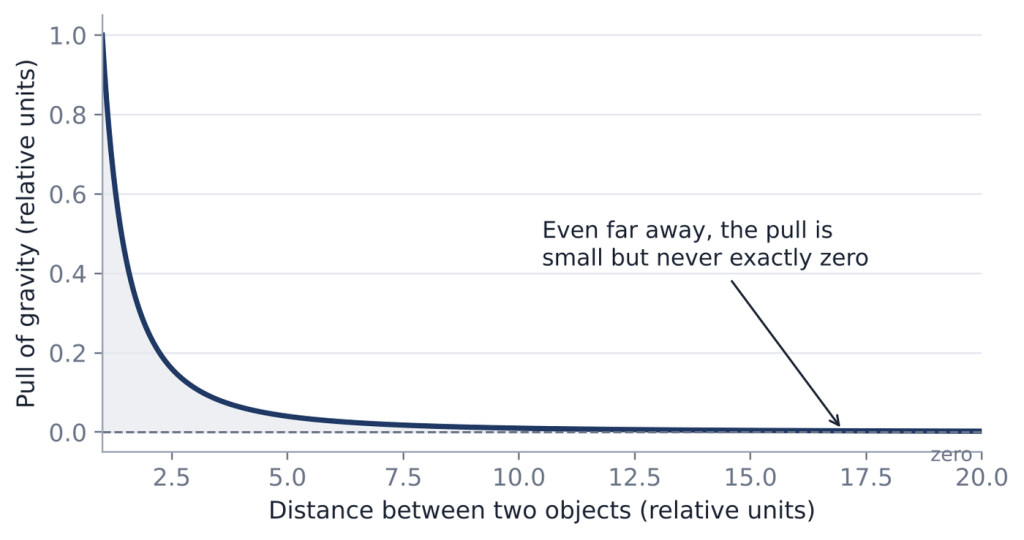
So when you stand up, your body’s mass shifts, and the balance of forces on the whole Earth changes by an amount too small for any instrument to detect. Too small to measure is not the same as zero.
2.2 The Habecker Principle
The Habecker Principle states that no object, person, or action can exist in a state of perfect neutrality: nothing has exactly zero effect (Habecker, 2026a). It has three parts:
- Physical non-neutrality. Every change in any mass produces a non-zero change in the forces acting everywhere else.
- Propagation. In connected systems, effects spread through physical, chemical, biological, and social channels. They fade, but they never fully disappear.
- Human implication. Because people are physical beings living in connected systems, no human action, presence, or choice produces exactly zero consequence.
This is different from the famous “butterfly effect,” the idea from weather science that a tiny change can sometimes lead to a very large result (Lorenz, 1963). The butterfly effect says some small causes have large effects. The Habecker Principle says every cause has some effect. It also does not claim that every effect is large, or even measurable. Non-zero is not the same as important.
An ancient text states a similar idea in moral terms: “Be not deceived; God is not mocked: for whatsoever a man soweth, that shall he also reap” (Galatians 6:7). Actions carry consequences forward.
Type of claim in this section: Physics (gravity never reaches zero). Analogy (extending this to all human action).
3. Everything Is Connected
3.1 The Bell and the Last Domino
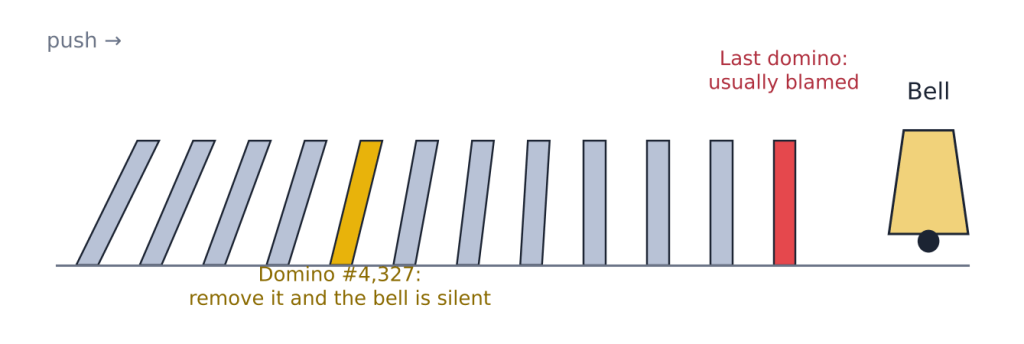
Imagine a line of 10,000 dominoes. The last one strikes a bell. Asked what rang the bell, nearly everyone points to domino number 10,000. It is nearest the outcome, it is the one we watched, and it made contact.
Yet in a single unbranched line, every domino passes the same test. Remove domino number 4,327 and the bell stays silent, exactly as it would if the last domino were removed. On the question “would the outcome have happened without this?”, the forgotten middle domino and the last one are equal. Figure 2 pictures the line.
Dominoes also show something more. A falling domino does not merely pass the push along. It releases its own stored energy as it falls, which is why one domino can knock over another about one and a half times its size (Whitehead, 1983). By the time the pulse reaches the bell, almost none of its energy comes from the first push. Every domino added to it.
3.2 Philosophers and Physicists Agree
Philosophers have long recognized that outcomes have many causes. John Stuart Mill argued that the true cause of an event is the whole set of conditions that came before it, and that singling out one of them as “the” cause is a practical choice, not a fact about the world (Mill, 1843). Later philosophers refined this idea (Mackie, 1965; Lewis, 1973).
Physics adds a precise picture. Influence travels no faster than light, so every event has a “past light cone”: the set of all earlier events that could have affected it (Einstein, 1905; Minkowski, 1909). Under the Habecker Principle, every event inside that cone contributes something. Events too far apart to affect each other still share a common origin, since in standard cosmology the whole observable universe descends from one early, connected region (Guth, 1981).
The result can be stated simply: every event is both a bell and a domino. It is the end point of everything that came before it, and a cause of everything that comes after.
Type of claim in this section: Physics (energy in dominoes, light cones). Philosophy (causes as sets of conditions).
4. Why We Blame the Last Domino
4.1 Three Examples
The highway. A driver cuts off another car and drives on. Minutes later, the car that was cut off collides with a truck, and its driver gets the ticket. The first driver never learns of the crash. The law treats the second driver’s handling of his car as the cause, a principle called proximate cause (Hart & Honoré, 1985). That ruling is reasonable for courts. But the first driver still changed the second car’s timing, its driver’s mood, and perhaps his behavior. He is legally clear but causally present.
The buzzer-beater. A basketball game ends on a missed shot at the buzzer, and popular memory blames that shot. But a basket missed in the first minute counts exactly as much as one missed in the last second. And a player who stepped right instead of left because he glanced at a spectator carrying popcorn was part of the chain too. The spectator was simply present, and that was enough to be connected.
The judge. A judge presides over a criminal trial, carefully placed outside the events being judged. But over decades, one life changes countless circumstances. The philosopher Derek Parfit showed that which people are born at all depends on extraordinarily precise timing (Parfit, 1984). Without the judge’s life, the world would differ enough that the defendant or the victim might never have existed. The judge has a passive connection to the crime: he did nothing toward it, yet his existence was never zero among its conditions.
4.2 What Experiments Show
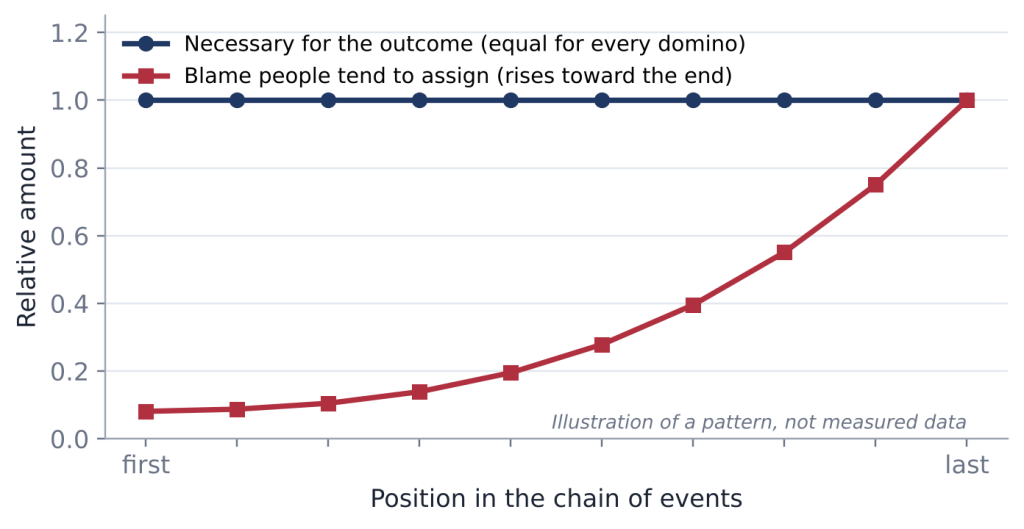
Research confirms that people blame the last link in a chain. Psychologists Dale Miller and Saku Gunasegaram found that people blame later events in a sequence more than earlier ones, even when both mattered equally, a pattern called the temporal order effect (Miller & Gunasegaram, 1990; see also Kahneman & Miller, 1986). David Lagnado and Shelley Channon found that people rate later events as more causal and more blameworthy, and also give more blame to actions that were intended and foreseeable (Lagnado & Channon, 2008; Alicke, 2000). Figure 3 illustrates the general pattern.
Philosophers call a related puzzle moral luck (Nagel, 1979; Williams, 1981). Two drivers make the same reckless lane change. One arrives home annoyed; the other’s victim dies. We judge the second driver more harshly, though both acted the same way. What differs is not the choice but how close each choice stood to a terrible outcome.
4.3 Three Tiers of Participation
If everyone is connected to everything, does that make everyone equally guilty? No. Connection is a floor, not a verdict. Table 2 separates three tiers.
Table 2. Three tiers of participation in an event.
| Tier | Definition | Who has it? | Example |
|---|---|---|---|
| 1. Passive connection | Existing among the conditions of an event, without acting toward it | Every person and event before it | A judge connected to a crime he later tries |
| 2. Active contribution | An act, chosen or reflexive, that directly shaped the chain | Some | A driver who cuts off another car |
| 3. Culpability | A chosen act, made with some awareness, measured against the moral standard | Fewer still | A person who chooses to do harm |
Everyone has Tier 1. Fewer reach Tier 2. Tier 3, real guilt, depends on what a person chose, not merely where they stood in the chain.
Type of claim in this section: Measured research (the temporal order effect). Philosophy (moral luck, the three tiers).
5. Everything Is Neutral in Sign
5.1 Connected to All Good and All Evil
If every event is connected to every earlier event, a striking conclusion follows: every person is connected to every good and every evil that has ever happened. The judge is passively connected to the crime he tries. He is connected in exactly the same way to every rescue, cure, and kindness that followed from his life. The novelist Fyodor Dostoevsky gave a character, the elder Zosima, a similar teaching: each person is in some sense responsible to all, for all (Dostoevsky, 1880/1912).
But this symmetry reveals something. If every person is equally connected to all good and all evil, then connection itself cannot be what makes anything good or evil. The same causal fabric carries the rescue and the murder.
5.2 Two Kinds of Neutrality
This seems at first to contradict the Habecker Principle. It does not, because there are two different kinds of neutrality:
- Neutrality of magnitude. Is an effect ever exactly zero? No. Nothing is neutral in effect.
- Neutrality of polarity. Does a connection carry a built-in moral sign, good or evil? No. Everything is neutral in sign.
This can be written as a simple formula:
V = m × p (2)
Here V is the moral value of a choice, m is its magnitude (how large its effect is), and p is its polarity (whether it counts as good or evil). Physics supplies m, and the Habecker Principle says m is never zero. Physics cannot supply p. This formula is a way of writing the idea clearly, not a quantity anyone can measure.
An example from electricity helps. A voltage reading means nothing until you choose a “ground,” the reference point that every voltage is measured against. Current flows through a circuit either way, but whether a point is positive or negative depends on the reference. The causal web is the circuit. Morality is the ground.
5.3 The Standard Must Come from Outside
If the physical system does not produce moral polarity, polarity must come from a standard outside it. The philosopher David Hume observed that facts about what is cannot, by themselves, tell us what ought to be (Hume, 1739). Physics can establish connection and consequence. It cannot establish value.
“Outside” here does not mean “made up.” The claim is the opposite of relativism: the standard is not produced by the system and cannot be changed by the people in it. Morality is not generated by the causal web; it is applied to it.
Two passages from the Bible describe both halves of this picture. On the neutral fabric:
He maketh his sun to rise on the evil and on the good, and sendeth rain on the just and on the unjust.Matthew 5:45
On the standard that sees beyond outward position:
For the LORD seeth not as man seeth; for man looketh on the outward appearance, but the LORD looketh on the heart.1 Samuel 16:7
5.4 A Specification for the Standard
If an outside standard exists, what does it look like? The Bible offers one in the form an engineer would call a specification. The Ten Commandments are mostly constraints: eight of the ten say what not to do (Exodus 20:1–17). When asked which commandment was greatest, Jesus summarized the whole in two positive requirements:
Thou shalt love the Lord thy God with all thy heart, and with all thy soul, and with all thy mind. This is the first and great commandment. And the second is like unto it, Thou shalt love thy neighbour as thyself. On these two commandments hang all the law and the prophets.Matthew 22:37–40
In engineering terms, the commandments are a prescriptive specification, listing specific failures to avoid, and Christ’s summary is a performance specification, stating the result required. Jesus also moved the standard from outward acts to inner intent: not only murder but anger, not only adultery but lust (Matthew 5:21–28). That matches Tier 3 in Table 2. The standard measures what a person chooses, not where the person happens to stand in the chain.
Type of claim in this section: Philosophy (two kinds of neutrality, the is-ought gap). Interpretation (the Bible as a specification of the outside standard).
Part Two: The Dynamics
6. Energy and Disorder in Plain Terms
Thermodynamics is the science of energy and heat. Two of its laws matter here.
- Energy is conserved. In a closed system, energy is never created or destroyed. It only changes form, such as from motion into heat. The mathematician Emmy Noether showed that this law follows from the fact that the laws of physics are the same at every moment in time (Noether, 1918).
- Entropy increases. Entropy measures disorder, or how spread out energy is. In a closed system, entropy tends to increase (Clausius, 1865). Ice melts in a warm room; a warm room never freezes a glass of water by itself. This one-way tendency is why time has a direction, which the astronomer Arthur Eddington called “time’s arrow” (Eddington, 1928).
Notice the phrase closed system: a system that nothing enters from outside. Both laws describe what happens inside such a system. Neither says anything about whether something outside could act on it. That detail matters throughout the rest of this paper.
Type of claim in this section: Physics.
7. Two Laws of Human Systems and the Boundary Principle
7.1 Law A and Law B
Families, communities, and nations behave in ways that resemble physical systems. Borrowing the structure of thermodynamics, this framework proposes two laws for human systems (Habecker, 2026b). An earlier version had four laws (Habecker, 2025). Testing showed that two were enough, and the idea that nothing is neutral moved from “law” to the foundation the laws rest on (Section 2).
- Law A: Human systems tend toward disorder in the absence of sustaining input.
- Law B: A system cannot generate within itself the resources sufficient to fully reverse its accumulated disorder.
Law A raises a question. If human systems drift toward disorder, is the fabric of the world tilted toward evil, contradicting Section 5? The answer depends on where the drift comes from. Physical entropy is a drift toward disorder, not toward evil; a melting ice cube is not wicked. The moral drift in human systems comes from the people in them, whose choices tend to pass harm forward through retaliation, resentment, and neglect. The fabric stays neutral. The drift is in the choices.
Law B has a reason rooted in Section 5. Every person is connected, at least passively, to all the harm in a human system. No member stands entirely clear of it. A system whose every member contributes to its disorder has no member who can fully undo it.
7.2 A Precise Version from Physics
The chemist Ilya Prigogine, who won the 1977 Nobel Prize in Chemistry, described how entropy changes in systems that exchange energy with their surroundings (Kondepudi & Prigogine, 1998). He split the change into two parts:
dS = deS + diS, where diS ≥ 0 (3)
Here dS is the total change in disorder. The term diS is the disorder produced inside the system, and it can never be less than zero. The term deS is the entropy exchanged with the outside, and it can be negative. So the only way for a system to become more ordered is with help from outside. A living cell stays organized only because it takes in energy from food or sunlight. Cut off that supply, and it falls apart.
7.3 The Boundary Principle
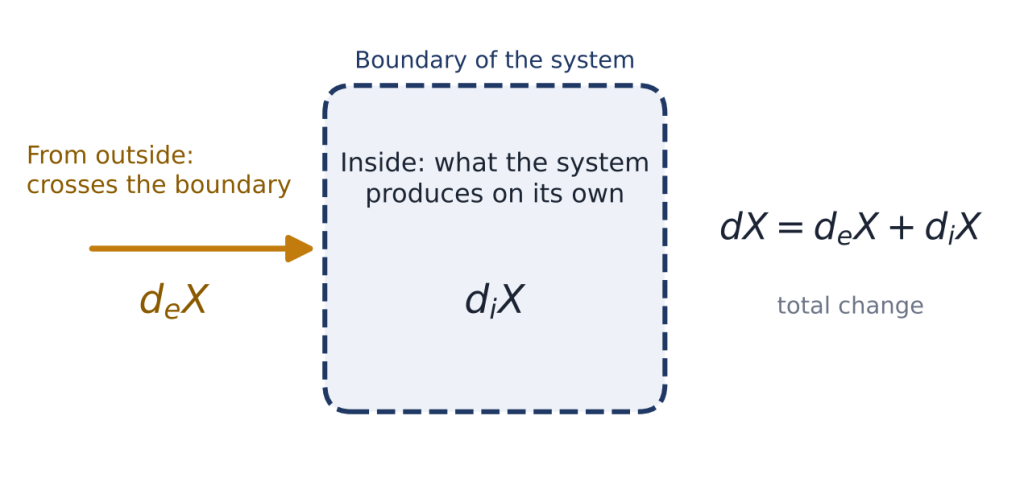
Equation (3) is one case of a general rule physicists call a balance law. For any quantity X, the change equals what crosses the boundary from outside plus what is produced inside, as Figure 4 shows:
dX = deX + diX (4)
What makes different quantities behave differently is the rule for the inside part. Table 3 compares three.
Table 3. Three quantities that follow the same balance pattern.
| Quantity | Rule for the inside part | In plain words | What only the outside can supply |
|---|---|---|---|
| Energy (E) | diE = 0 | A closed system cannot create energy. | New energy |
| Entropy (S) | diS ≥ 0 | A system left alone only adds disorder. | Order (restoration) |
| Moral polarity (p) | dip = 0 | The system produces effects, but never a moral sign. | Meaning (judgment) |
The first two rows are established physics. The third is this framework’s hypothesis, extending the same pattern to moral meaning. Read together, they suggest one principle, called here the Boundary Principle: what a system cannot produce, it must receive from outside.
Type of claim in this section: Physics (Equations 3 and 4, rows one and two of Table 3). Analogy (Laws A and B). Hypothesis (row three of Table 3).
Part Three: Purpose and Limits
8. A Stage for Choice
8.1 The Hypothesis
Why would a world have real effects but no built-in morality? This framework proposes a hypothesis: the physical world, including its laws of energy and disorder, exists to make real human choice possible, and above all the choice to accept or reject the Creator. The idea is old. Moses set the choice before the people of Israel plainly:
I have set before you life and death, blessing and cursing: therefore choose life.Deuteronomy 30:19
If the purpose of the world is real choice, the world would need certain features. Table 4 lists six, each matched with a feature our world actually has.
Table 4. Six requirements for real choice and the physical features that meet them.
| Requirement for real choice | Feature of the physical world | Why choice needs it |
|---|---|---|
| Choices must matter | Nothing has exactly zero effect | A choice that left no trace would not count for anything. |
| Choices must be final | Entropy gives time one direction | A choice that could be perfectly undone would never really be decided. |
| Results must be foreseeable | Stable, uniform physical laws | People can only be responsible for what they can reasonably predict. |
| Choices must cost something | Energy and time are limited | Choosing one path means giving up another, so sacrifice is possible. |
| The world must not decide for us | The causal fabric carries no moral sign | If physics pushed people toward good, choosing good would not be free. |
| God must not overwhelm the choice | The Creator is outside the system, not one more visible object in it | If God were impossible to doubt, choosing Him would be forced. |
Several thinkers have argued in similar directions. Alvin Plantinga argued that a world with truly free creatures is better than a world of robots, even though freedom makes evil possible (Plantinga, 1974). John Hick described the world as a place for “soul-making,” and proposed an epistemic distance between God and people: God stays hidden enough that believing in Him is free rather than forced (Hick, 1966). Blaise Pascal wrote that God gives enough light for those who seek Him and enough shadow for those who do not (Pascal, 1670/1966). Richard Swinburne argued that people need stable natural laws to learn what their actions will cause (Swinburne, 2004). The new contribution here is to connect these ideas to the specific laws of energy and disorder.
8.2 Miracles Without Breaking the Laws
The hypothesis also holds that the Creator can put real energy into the world. A common objection is that this would break the law of conservation of energy. A simple energy balance shows why it would not:
ΔE = Ein − Eout (5)
The change in a system’s energy (ΔE, where Δ means “change in”) equals the energy coming in minus the energy going out. In a closed system both are zero, so energy is conserved. But the law only holds while the boundary is closed. If energy is added from outside, Ein is not zero, and the system’s energy rises with no law broken (Larmer, 1988). C. S. Lewis described a miracle in a way that fits the domino picture: it does not suspend nature’s laws but feeds a new event into nature, which those laws then carry forward as usual (Lewis, 1947). In domino terms, a hand from outside pushes one domino, and every domino after it falls by ordinary physics.
The hypothesis predicts that such interventions must be rare. Constant miracles would make the world unpredictable, and the stable laws that responsible choice depends on would collapse.
Type of claim in this section: Physics (Equation 5). Interpretation (the purpose of the world; the Creator’s ability to act).
9. Suffering and the Wrong Domino
9.1 The Oldest Question
When something terrible happens to a good person, people ask: how could God let this happen? The question is ancient. The book of Job, one of the oldest texts in the Bible, is built around it, and it remains one of the hardest questions any view of God must face. The framework does not make suffering smaller. But it shows that common ways of interpreting suffering contain three predictable errors.
9.2 Three Errors
The proximity error. When a tragedy is large and no human cause is visible, people look for a cause big enough to match the pain, and often the only one large enough is God. Psychologists Kurt Gray and Daniel Wegner found that people expect harm to have an intentional agent behind it, and when none is visible, they often assign the role to God (Gray & Wegner, 2010). Anger toward God is common after loss and illness (Exline et al., 2011). In domino terms, the sufferer skips past thousands of hidden links to the one participant who can be named.
The outcome error. Many people quietly assume the world is fair, so that people get what they deserve. The psychologist Melvin Lerner called this the belief in a just world (Lerner, 1980). Its dark side is that people who suffer are assumed to have earned it. Jesus rejected this reading directly. Of eighteen people killed when a tower fell, He asked whether they were worse sinners than everyone else, and answered: “I tell you, Nay” (Luke 13:4–5). When His disciples asked whose sin caused a man to be born blind, He answered: “Neither hath this man sinned, nor his parents” (John 9:3).
The labeling error. The question “why do bad things happen to good people?” assumes we know who the good people are. But that label is a judgment made from inside the chain, from outward appearance (1 Samuel 16:7).
9.3 Why Not Shield the Good?
If God can act, why not simply protect good people? The framework points to two reasons. First, the world’s laws would stop being reliable. A world where fire refused to burn the righteous would be unpredictable, and responsibility would collapse for everyone. A world with reliable gravity is a world where people can fall. Second, goodness would become a transaction. If goodness reliably bought protection, people would choose good for safety, the way a customer buys insurance. That is exactly the accusation at the start of Job: “Doth Job fear God for nought? Hast not thou made an hedge about him?” (Job 1:9–10). The whole book tests whether goodness can be real when it is not rewarded.
9.4 Every Bell Is Also a Domino
Suffering is a bell, the result of a long chain. But the response to suffering becomes a domino. Bitterness and revenge push forward into the chain; so do compassion and forgiveness. The outside standard does not measure what happened to a person. It measures what the person chooses next.
When God finally answers Job, He does not explain Job’s suffering. He asks Job where he was when the foundations of the earth were laid (Job 38:4). The point is not that Job’s pain did not matter, but that Job was judging a system he could not see from outside. The same book rebukes Job’s friends, who insisted Job must have sinned (Job 42:7). It condemns both errors: judging God from inside the chain, and judging the sufferer from inside the chain.
These answers have limits. They explain why suffering is possible in a world of real choice, not why any particular person suffers. The philosopher Marilyn McCord Adams argued that some evils are so severe that no general reason can answer them, only God’s direct involvement with the sufferer (Adams, 1999). Natural disasters and disease, where no human chooser is in sight, remain the hardest cases.
Type of claim in this section: Measured research (blaming God, the just-world belief). Interpretation (why a world of choice cannot shield the good).
10. The Resolution Limit
10.1 Every Judgment Is a Measurement
Two sincere people can read the same scripture and reach opposite verdicts about a person or event. If the standard is perfect, why the disagreement? Scientists describe every measurement with the same basic idea: what you measure equals the true value plus some error (JCGM, 2008; Lord & Novick, 1968).
M = T + ε (6)
Here M is the measured value, T is the true value, and ε (epsilon) is the error. Applied to moral judgment, T is the true assessment by the outside standard, and M is the human verdict. The verdict may be close, even correct in direction, but some error always remains, because the person judging stands inside the system being judged.
Every instrument also has a resolution, the smallest detail it can distinguish. Human moral sight has a resolution limit: we cannot see motives directly, the long chain of earlier causes, or what a person privately faced and resisted. Paul described the limit:
For now we see through a glass, darkly; but then face to face: now I know in part; but then shall I know even as also I am known.1 Corinthians 13:12
10.2 Where the Error Comes From
Error enters in two places. First, readers interpret the moral standard through their own culture and assumptions. Second, and larger, error enters when that reading is applied to real people. Research shows how. People over-read character from behavior and ignore circumstances, a pattern called the fundamental attribution error (Jones & Harris, 1967; Ross, 1977). People see bias in others more easily than in themselves, the bias blind spot (Pronin, Lin, & Ross, 2002), which is the scientific form of Jesus’ warning about seeing the speck in a brother’s eye while missing the beam in one’s own (Matthew 7:3–5). And people often cannot accurately report why they made their own choices (Nisbett & Wilson, 1977). The prophet Jeremiah said the heart is deceitful, and only the Lord truly searches it (Jeremiah 17:9–10).
10.3 Where the Error Grows
Error grows as the judge moves farther from the information that matters most, the chooser’s intent. Figure 5 and Table 5 rank four kinds of judgment.
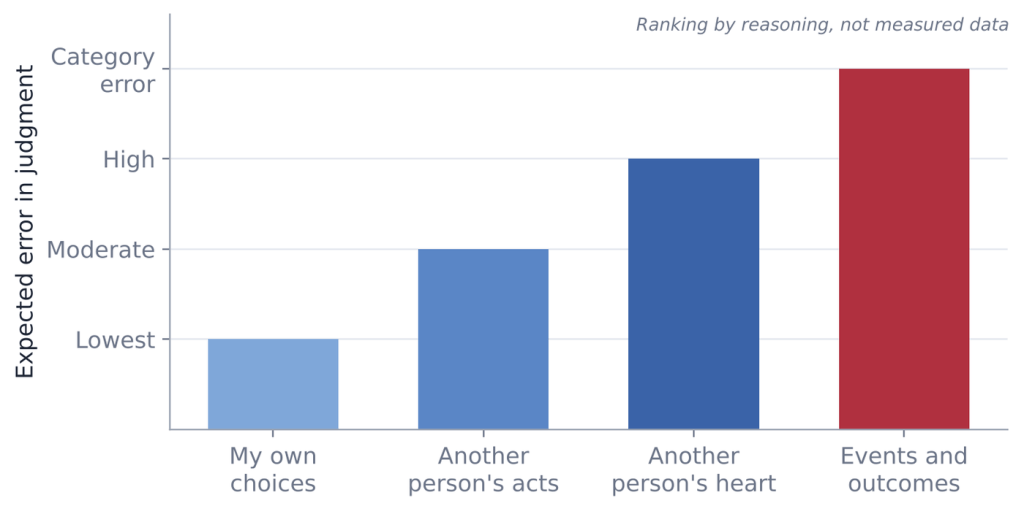
Table 5. The resolution limit across four kinds of judgment.
| What is being judged | Information available | Fitting stance |
|---|---|---|
| My own choices | The most: my motives, history, and intent, though even these are partly hidden | Apply the moral standard firmly |
| Another person’s acts | Outward behavior and some evidence | Judge carefully; stay open to correction |
| Another person’s heart | Almost none: motives are invisible | Withhold final verdicts |
| Events and outcomes | A few links of a vast chain, and no chooser’s intent to measure | Do not read God’s verdict into what happens |
The last row is not a small error. It is measuring the wrong thing. The moral standard measures choices. A flood has no intent; there is nothing in it to measure. Reading a tragedy as proof of guilt, or a blessing as proof of approval, treats the size of an effect (magnitude) as if it were its moral sign (polarity).
This does not mean no one can judge anything. Societies must judge acts, and scripture calls for it: “Judge not according to the appearance, but judge righteous judgment” (John 7:24). What lies beyond human sight is the final verdict on a heart: “Who art thou that judgest another man’s servant?” (Romans 14:4). This is not relativism. There is a true standard, and that is exactly why human readings of it call for humility.
Type of claim in this section: Measurement science (Equation 6). Measured research (attribution, bias, self-knowledge). Interpretation (the practical ethic).
Part Four: Restoration
11. What Complete Restoration Would Require
11.1 Eight Specifications
If Laws A and B are true, then a human system that has accumulated disorder cannot fully restore itself. What would complete restoration require? Working from the two laws and the idea of a stage for choice, the framework identifies eight specifications (Habecker, 2025, 2026b), shown in Table 6.
Table 6. Eight specifications for complete restoration.
| Specification | What it requires | Source |
|---|---|---|
| R1. External origin | The restoring input must come from outside the system. | Law B |
| R2. External standard | What counts as “restored” must be defined from outside the system. | Neutral polarity |
| R3. Proportional to the whole debt | The input must match all the disorder ever accumulated, not just today’s condition. | Law A |
| R4. An inexhaustible absorber | The restorer takes in effects without being used up or passing them on. | Laws A and B |
| R5. Sustained input | Restoration must keep flowing, not happen only once. | Law A |
| R6. A new endpoint | The restored state is something new, not a return to the past. | Entropy |
| R7. Freely given | The restorer acts by choice, not by force. | Stage for choice |
| R8. Freely receivable by all | Restoration is open to every person, and each is free to accept or refuse it. | Stage for choice |
The first six follow from the laws of disorder. They describe what restoration must do, the way an engineer describes what a repair must accomplish. The last two follow from the stage for choice. A restoration forced on anyone would destroy the very freedom the world exists to protect.
11.2 Absorbing Without Erasing: The Ideal Reservoir
Specification R4 raises a puzzle. An earlier version of this framework said consequences must be terminated, not just moved around (Habecker, 2025). But Section 2 says no effect ever reaches zero. How can both be true?
Thermodynamics offers an answer: the thermal reservoir, a body so large it can absorb heat without its own temperature changing noticeably (Çengel & Boles, 2015). The ocean is a familiar example. The rule for how much a body’s temperature rises when it absorbs heat is:
ΔT = Q / C (7)
Here ΔT is the temperature change, Q is the heat absorbed, and C is the body’s heat capacity. Figure 6 shows that the larger C is, the smaller the change. An ideal reservoir has a capacity so large that its temperature does not change at all.
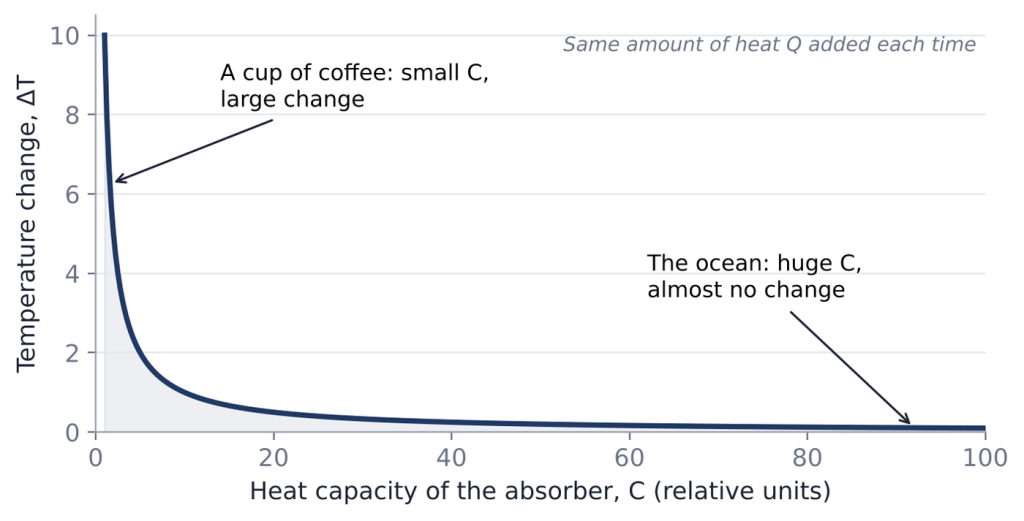
In an ideal reservoir, heat does not disappear; energy is conserved and nothing is erased. But the reservoir does not pass the heat back into the system either. The effect has been received by something large enough that it stops there. Applied to restoration, consequences are not made to vanish, which would contradict the Habecker Principle. They are taken in by an absorber with unlimited capacity, who does not pass them forward.
11.3 A New Endpoint
Specification R6 follows from time’s arrow. Because disorder runs in one direction, the past cannot be restored exactly. Restoration, if it comes, must move forward into something new rather than backward into what was.
Type of claim in this section: Analogy (the specifications). Physics (Equation 7, the reservoir).
12. How the Christian Account Describes Itself
Earlier work in this framework concluded that the Christian account of the Cross describes all eight specifications at its core (Habecker, 2025, 2026b). Table 7 shows how that account describes itself in its own words.
Table 7. The eight specifications as described in the Christian account.
| Specification | How the Christian account describes it |
|---|---|
| R1. External origin | God, the Creator outside the system, is the source: “For God so loved the world, that he gave his only begotten Son” (John 3:16). |
| R2. External standard | The standard is God’s own nature: “God is love” (1 John 4:8). |
| R3. Proportional to the whole debt | The Cross is presented as dealing with “the sins of the whole world” (1 John 2:2). |
| R4. An inexhaustible absorber | Christ takes the blow without passing it on: “Father, forgive them; for they know not what they do” (Luke 23:34). “He hath borne our griefs, and carried our sorrows” (Isaiah 53:4). |
| R5. Sustained input | Grace is ongoing: God’s compassions “are new every morning” (Lamentations 3:22–23). |
| R6. A new endpoint | Not a return to Eden but a new creation: “Behold, I make all things new” (Revelation 21:5). |
| R7. Freely given | “No man taketh it from me, but I lay it down of myself” (John 10:18). |
| R8. Freely receivable by all | “Whosoever believeth in him should not perish” (John 3:16). |
Two points deserve attention. First, R4 and the ideal reservoir fit the account’s own language: Christ is described as taking the blow without retaliating or passing it on. In domino terms, the One outside the chain stepped into it and stood where the last domino falls. The writer of Hebrews says this means God can sympathize with human weakness from the inside (Hebrews 4:15). Second, R5 adds something a single event cannot: restoration described as ongoing, renewed daily, the way a living cell stays organized only through a steady flow from outside.
For objectivity, two cautions belong here. This table shows how the Christian account describes itself; it does not prove the account is true. And the specifications were developed with the Christian account in view, so its close fit may partly reflect how the specifications were built. The framework’s own earlier work acknowledges this possible circularity (Habecker, 2026b).
Type of claim in this section: Interpretation. Comparison of the framework with a tradition’s self-description.
13. Love: The Specification That Works Anyway
13.1 Rules That Pass Error Through
Section 10 left a practical problem. If human judgment always carries error, how should anyone live? Many moral rules work like this: first decide what the other person deserves, then respond. Any response that depends on a verdict inherits the verdict’s error:
R = f(M) = f(T + ε) (8)
Here R is the response and f is the rule that turns a verdict into action. If the verdict is wrong, so is the response. Engineers face the same problem with machines that depend on imperfect measurements. The engineer Genichi Taguchi made a solution famous: design the system so its performance does not depend on the error (Taguchi, 1986). This is called robust design.
13.2 The Greatest Commandment Is Robust
The two great commandments, drawn from Deuteronomy 6:5 and Leviticus 19:18, have exactly this property. Loving God means orienting one’s life to the outside standard, without needing to see the whole chain. Loving one’s neighbor governs my actions, the row of Table 5 with the least error. It does not require first deciding whether the neighbor is good or deserving. In the language of Equation (8), love removes the dependence on the verdict:
R = L (independent of ε) (9)
Here L stands for love, a response chosen because of who I am called to be, not because of a judgment about who you are. The philosopher Søren Kierkegaard argued that love for one’s neighbor differs from love based on preference because it does not depend on the qualities of the person loved (Kierkegaard, 1847/1962).
Jesus removed the verdict in three places. When asked “who is my neighbour?”, a request for a rule to sort people, He told the parable of the Good Samaritan and turned the question around: which person acted as a neighbor (Luke 10:29–37)? He taught love for enemies and gave the reason in the very next breath, the neutral fabric itself:
Love your enemies, bless them that curse you, do good to them that hate you … that ye may be the children of your Father which is in heaven: for he maketh his sun to rise on the evil and on the good.Matthew 5:44–45
And Paul’s “through a glass, darkly” sits inside his chapter on love. His reasoning runs exactly as this paper’s does: we see only in part, therefore what remains is faith, hope, and love, “but the greatest of these is charity” (1 Corinthians 13:13), where “charity” translates the Greek word for self-giving love.
13.3 Love Is Received First
Love also follows the Boundary Principle. “God is love” (1 John 4:8), so to love is not only to obey the outside standard but to resemble it. And people are not its original source: “We love him, because he first loved us” (1 John 4:19). By Law B, no one inside the system can be the ideal reservoir. But people can do something smaller and real. Forgiveness is a local, limited form of absorption: it does not erase what happened, but it refuses to pass it onward. When people love their neighbors, they become part of the channel through which sustained input (R5) reaches the rest of the system.
Love does not mean ignoring wrongdoing. Protecting the vulnerable and holding people accountable for their acts can be acts of love. What love removes is the final verdict on a person’s worth. Nor is love only a feeling. Paul defined it almost entirely by behavior: patient, kind, not envious or proud (1 Corinthians 13:4–7), and C. S. Lewis distinguished this self-giving love from affection and attraction (Lewis, 1960).
Type of claim in this section: Engineering analogy (robust design). Interpretation (love as the robust specification).
Part Five: Other Traditions
14. Comparing the Pattern Across Traditions
14.1 Method and Cautions
If the moral standard is real and built into how people were made, traces of it should appear among peoples who never read the Bible. Paul made this argument: people without the written law can show “the work of the law written in their hearts” (Romans 2:15), and God “left not himself without witness” among any people (Acts 14:17).
To test this, the eight specifications were compared with the teachings of six traditions: Christianity, Judaism, Islam, Hinduism, Buddhism, and four Native American nations (the Haudenosaunee, Lakota, Diné, and Anishinaabe). Each comparison was rated as meets it, in part, or approaches it differently. Three cautions apply. Every tradition is internally diverse, and its followers would describe restoration in their own terms. The ratings are judgments, not measurements. And because the specifications were built with the Christian account in view, the comparison is not neutral ground. Figure 7 shows the results as beams of light from the eight specifications to each tradition.
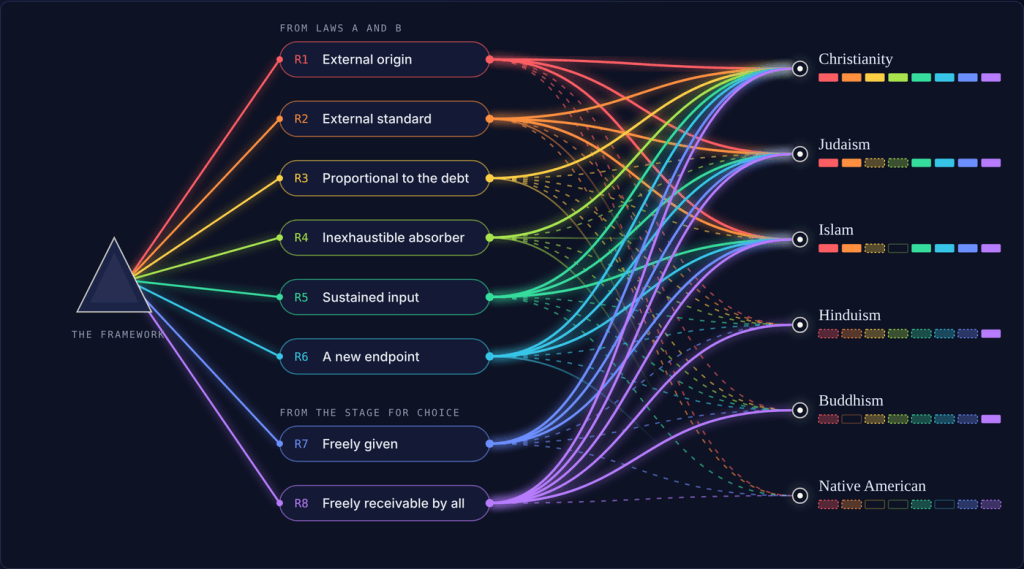
Table 8. Summary of the comparison.
| Tradition | Meets it | In part | Approaches it differently |
|---|---|---|---|
| Christianity | 8 | 0 | 0 |
| Judaism | 6 | 2 | 0 |
| Islam | 6 | 1 | 1 |
| Hinduism | 1 | 7 | 0 |
| Buddhism | 1 | 6 | 1 |
| Native American (four nations studied) | 0 | 5 | 3 |
14.2 What the Comparison Shows
Judaism shares the source texts of both great commandments. Rabbi Hillel summarized the law as “What is hateful to you, do not do to your neighbor” (Babylonian Talmud, Shabbat 31a). Islam strongly affirms a Creator outside the system and an external standard, but it deliberately rejects a substitute who bears another’s burden: “no bearer of burdens will bear the burden of another” (Qur’an 6:164). That is why its R4 beam is marked as a different approach rather than a gap.
Hinduism and Buddhism describe the Habecker Principle’s idea of consequence very fully through karma, and Buddhism’s teaching of dependent origination, that every event arises from conditions, closely matches the idea that everything is connected. But karma builds moral polarity into the causal fabric, the opposite of Section 5. This is the deepest dividing line the comparison found: is moral meaning built into the world, or applied to it from outside?
The four Native American nations studied show strong agreement on several foundations. The Lakota phrase Mitákuye Oyás’iŋ, “all my relatives,” expresses kinship with all creation. The Haudenosaunee are known for asking leaders to consider the effects of decisions on the seventh generation to come (Wallace, 1946). The Anishinaabe Seven Grandfather Teachings include love and humility (Benton-Banai, 1988), and Navajo peacemaking restores relationships rather than measuring a person’s worth (Yazzie, 1994). These traditions were mostly recorded after European contact (Walker, 1980; Brown, 1953; Witherspoon, 1977), and some popular “Native sayings” are not Native at all. The well-known line about walking a mile in another’s moccasins comes from an 1895 poem by Mary T. Lathrap (Lathrap, 1895). Native authors have also pointed out the harm done when Christianity arrived alongside conquest (Deloria, 1973; Tinker, 1993).
Across all six, the parts of the pattern that can be learned from living in the world, such as connection, consequence, humility, and love, appear most widely. The parts most tied to a specific revelation appear less widely. That fits Paul’s distinction between what can be “clearly seen, being understood by the things that are made” (Romans 1:20) and what must be told (Romans 10:14).
Type of claim in this section: Comparative judgment. Interpretation.
Part Six: The Unseen Spectrum
15. Light Beyond the Visible
Look again at Figure 7. Some traditions show every color; others show some colors faded or missing. It is tempting to read the chart as complete. Physics suggests caution.
Human eyes see light with wavelengths from about 400 to 700 nanometers. That band is a thin slice of the whole electromagnetic spectrum, shown in Figure 8. Infrared, ultraviolet, radio waves, and X-rays are just as real, and invisible to us. Bees and many birds see ultraviolet patterns on flowers that people never notice.
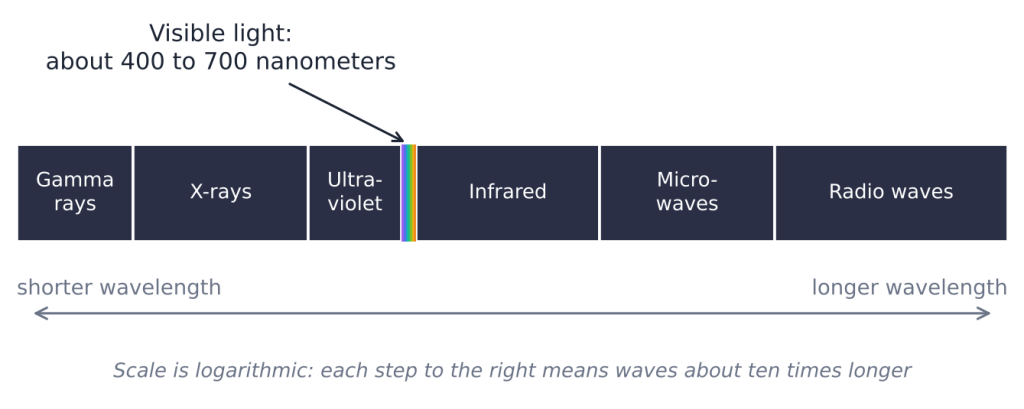
The eight specifications are like visible light. They are what this instrument, a framework built from thermodynamics, can detect. Thermodynamics can describe effects, flows, disorder, and inputs. It has no categories for some things that may matter most. Figure 9 adds two dim bands, beyond red and beyond violet, to stand for what the framework cannot measure.
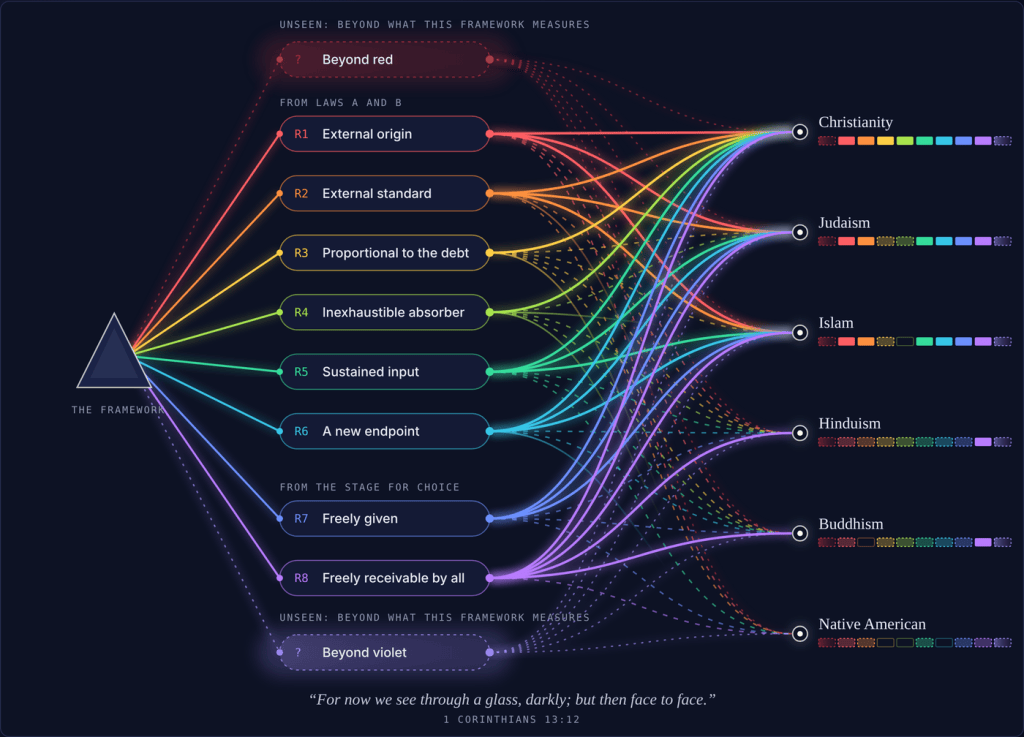
What might lie in the unseen bands? These are possibilities, not findings:
- Relationship: knowing God as a person, not only as a standard.
- The inner work of the Spirit, which no outside observer can measure.
- How much light each person actually received.
- Love as a personal act, not only a rule of conduct.
- Variables inside the system that this framework has not yet named.
- Realities with no name in any human language.
Paul’s own image fits. The word translated “glass” in 1 Corinthians 13:12 is the Greek esoptron, a mirror. Mirrors in Paul’s day were polished bronze and gave dim, imperfect reflections. Every view of the perfect standard from inside the system is, in that sense, a faded reflection, and the chart can show only the part of the reflection its instrument can detect.
Type of claim in this section: Physics (the electromagnetic spectrum). Analogy (the framework as an instrument with a limited band).
16. An Interpretation: Grace
This section offers an interpretation. It is labeled as such because it goes beyond what the pattern matching can show. The chart says only that the connection is unknown. What follows is one reading of that unknown.
The eight beams measure what each tradition’s teaching describes. Grace as a teaching already appears there, in R5 (sustained input) and R7 (freely given). What the unseen bands might hold is grace as an act: the outside standard at work beyond what any tradition has described or any chart can detect. Grace has exactly the properties that would keep it off the chart:
- It comes from outside the system. By Law B, the system cannot produce it. It is the purest case of the Boundary Principle: received, never generated.
- It does not follow proportional accounting. Specification R3 asks whether restoration matches the debt. Grace overshoots it: “where sin abounded, grace did much more abound” (Romans 5:20). A framework built on balance laws has no column for something that exceeds the balance.
- It is invisible in operation. Jesus described the Spirit’s work this way: “The wind bloweth where it listeth, and thou hearest the sound thereof, but canst not tell whence it cometh, and whither it goeth” (John 3:8). Effects are seen; the source is not.
- It is unearned. “For by grace are ye saved through faith; and that not of yourselves: it is the gift of God” (Ephesians 2:8). Anything a tradition could score points for would, in a sense, not be grace.
This interpretation bears on the hardest question the comparison raised: what of people who never heard the gospel? A tradition’s bar in Figure 7 shows what its teaching names, but grace, if it is real, is not limited to what people have named. Paul told the Athenians that God placed every nation where it is “that they should seek the Lord, if haply they might feel after him, and find him, though he be not far from every one of us” (Acts 17:27). Christians have answered this question in different ways. C. S. Lewis held that no one is saved except through Christ, but that we do not know that only those who know Him by name can be saved through Him (Lewis, 1952). The resolution limit counsels humility here most of all. The verdict belongs to the One outside the chain, and Abraham’s question stands behind every case we cannot see into:
Shall not the Judge of all the earth do right?Genesis 18:25
Type of claim in this section: Interpretation.
17. Limitations
The laws are analogies. Laws A and B borrow the structure of thermodynamics. They are not physical laws, and none of the equations in this paper measures a moral quantity. Equations 1, 3, 4, 5, and 7 describe real physics; Equations 2, 8, and 9 are ways of writing ideas clearly; Equation 6 describes measurement in general.
The framework may be circular. The restoration specifications were developed with the Christian account in view. Its close fit may partly reflect how they were built. Ruling this out would require testing the framework from a different starting point (Habecker, 2026b).
The ratings are judgments. The comparison of traditions reflects one reading of each tradition’s mainstream teaching. Followers of those traditions would describe restoration in their own terms, and some ratings could reasonably differ.
Fit is not proof. Showing that an account is consistent with the framework does not show that it is true. Shared moral insights across cultures are consistent with a real outside standard, and also with other explanations, such as common human experience (Popper, 1959, on the limits of untestable claims).
The hardest cases remain hard. The framework explains why suffering is possible in a world of real choice, not why any particular person suffers. Explanation is not comfort, and it should never be offered in place of presence.
18. Conclusion: From Gravity to Grace
This paper began with a small fact: standing up from a chair moves the Earth by an amount too small to measure, but not zero. Table 9 summarizes the steps that followed.
Table 9. The whole argument in twelve steps.
| Step | Claim | Type |
|---|---|---|
| 1 | Nothing has exactly zero effect. | Physics |
| 2 | Every event is connected to every earlier event. | Physics and philosophy |
| 3 | People blame whatever stands nearest the outcome. | Measured research |
| 4 | Connections carry effects but no moral sign, so moral meaning comes from outside. | Philosophy |
| 5 | Human systems drift toward disorder and cannot fully restore themselves. | Analogy |
| 6 | What a system cannot produce, it must receive from outside. | Physics and analogy |
| 7 | The world’s features fit what real choice would require. | Interpretation |
| 8 | People misread suffering by blaming the nearest cause and judging by outcomes. | Measured research and interpretation |
| 9 | Human moral judgment approximates the true standard but cannot equal it. | Measurement science and interpretation |
| 10 | Complete restoration would need eight specifications, and the Christian account describes all eight. | Analogy and interpretation |
| 11 | Love is the moral specification that works despite limited sight. | Analogy and interpretation |
| 12 | Every tradition shows part of the pattern, and some of the picture lies beyond what this method can measure. | Comparison and interpretation |
Nothing is neutral in effect. Everything is neutral in sign. Human systems drift toward disorder, and no system can save itself; what it cannot produce, it must receive from outside. The world appears built for real choice, which is why it cannot shield the good without breaking its own laws or turning goodness into a purchase. Human judgment sees only in part, so the moral specification best suited to us is love, which needs no verdict first and is received before it is given.
Every tradition examined shows part of this pattern. And beyond the eight colors this method can detect lies a spectrum it cannot see, where the connection to each person and each people is unknown to us. One interpretation names that unseen light grace. Whether or not a reader accepts that interpretation, the physics makes one point plain: the light we can see is not all the light there is.
Nothing is neutral in effect. Everything is neutral in sign. No system can save itself. What it cannot produce, it must receive. We see in part, so love anyway, and remember that the light we see is not all the light there is.
References
Adams, M. M. (1999). Horrendous evils and the goodness of God. Cornell University Press.
Alicke, M. D. (2000). Culpable control and the psychology of blame. Psychological Bulletin, 126(4), 556–574.
Babylonian Talmud. Shabbat 31a.
Benton-Banai, E. (1988). The Mishomis book: The voice of the Ojibway. Indian Country Communications.
Brown, J. E. (1953). The sacred pipe: Black Elk’s account of the seven rites of the Oglala Sioux. University of Oklahoma Press.
Çengel, Y. A., & Boles, M. A. (2015). Thermodynamics: An engineering approach (8th ed.). McGraw-Hill Education.
Clausius, R. (1865). Über verschiedene für die Anwendung bequeme Formen der Hauptgleichungen der mechanischen Wärmetheorie [On several convenient forms of the fundamental equations of the mechanical theory of heat]. Annalen der Physik, 201(7), 353–400.
Deloria, V., Jr. (1973). God is red. Grosset & Dunlap.
Dostoevsky, F. (1912). The Brothers Karamazov (C. Garnett, Trans.). Heinemann. (Original work published 1880)
Eddington, A. S. (1928). The nature of the physical world. Cambridge University Press.
Einstein, A. (1905). Zur Elektrodynamik bewegter Körper [On the electrodynamics of moving bodies]. Annalen der Physik, 17(10), 891–921.
Exline, J. J., Park, C. L., Smyth, J. M., & Carey, M. P. (2011). Anger toward God: Social-cognitive predictors, prevalence, and links with adjustment to bereavement and cancer. Journal of Personality and Social Psychology, 100(1), 129–148.
Gray, K., & Wegner, D. M. (2010). Blaming God for our pain: Human suffering and the divine mind. Personality and Social Psychology Review, 14(1), 7–16.
Guth, A. H. (1981). Inflationary universe: A possible solution to the horizon and flatness problems. Physical Review D, 23(2), 347–356.
Habecker, M. J. (2025). The Pattern: A proposed universal field theory of consequence. Moral Architecture Thought Experiments. https://moralarchitecture.com/
Habecker, M. J. (2026a). The Habecker Principle: Nothing you do is without effect. Moral Architecture Thought Experiments. https://moralarchitecture.com/the-habecker-principle-3-19-26/
Habecker, M. J. (2026b). Two laws are sufficient: Parsimony, stability, and the limits of philosophical stress testing. A structural revision of the thermodynamic laws of human systems. Moral Architecture Thought Experiments. https://moralarchitecture.com/two-laws-are-sufficient-parsimony-stabilityand-the-limits-of-philosophical-stress-testing-a-structural-revision-of-the-thermodynamic-laws-of-human-systems-5-21-2026/
Habecker, M. J. (2026c). The last domino: Causal universality, moral polarity, and the external standard [Unpublished manuscript].
Habecker, M. J. (2026d). The stage for choice: Thermodynamics, free will, and a Creator outside the system [Unpublished manuscript].
Habecker, M. J. (2026e). The wrong domino: Suffering, blame, and the One outside the chain [Unpublished manuscript].
Habecker, M. J. (2026f). The resolution limit: Why human moral judgment approximates but cannot equal the Creator’s view [Unpublished manuscript].
Habecker, M. J. (2026g). The specification that works anyway: Love as the greatest commandment for people who see in part [Unpublished manuscript].
Habecker, M. J. (2026h). Written on the heart: Native American traditions and the Moral Architecture framework [Unpublished manuscript].
Habecker, M. J. (2026i). From gravity to grace: A reconciliation of the Moral Architecture framework [Unpublished manuscript]; and The restoration spectrum and The unseen spectrum [Interactive charts].
Hart, H. L. A., & Honoré, T. (1985). Causation in the law (2nd ed.). Clarendon Press.
Hick, J. (1966). Evil and the God of love. Macmillan.
Hume, D. (1739). A treatise of human nature. John Noon.
Joint Committee for Guides in Metrology. (2008). Evaluation of measurement data: Guide to the expression of uncertainty in measurement (JCGM 100:2008). BIPM.
Jones, E. E., & Harris, V. A. (1967). The attribution of attitudes. Journal of Experimental Social Psychology, 3(1), 1–24.
Kahneman, D., & Miller, D. T. (1986). Norm theory: Comparing reality to its alternatives. Psychological Review, 93(2), 136–153.
Kierkegaard, S. (1962). Works of love (H. V. Hong & E. H. Hong, Trans.). Harper & Row. (Original work published 1847)
Kondepudi, D., & Prigogine, I. (1998). Modern thermodynamics: From heat engines to dissipative structures. Wiley.
Lagnado, D. A., & Channon, S. (2008). Judgments of cause and blame: The effects of intentionality and foreseeability. Cognition, 108(3), 754–770.
Larmer, R. A. H. (1988). Water into wine? An investigation of the concept of miracle. McGill-Queen’s University Press.
Lathrap, M. T. (1895). Judge softly. In The poems and written addresses of Mary T. Lathrap. Woman’s Christian Temperance Union of Michigan.
Lerner, M. J. (1980). The belief in a just world: A fundamental delusion. Plenum Press.
Lewis, C. S. (1947). Miracles: A preliminary study. Geoffrey Bles.
Lewis, C. S. (1952). Mere Christianity. Geoffrey Bles.
Lewis, C. S. (1960). The four loves. Geoffrey Bles.
Lewis, D. (1973). Causation. The Journal of Philosophy, 70(17), 556–567.
Lord, F. M., & Novick, M. R. (1968). Statistical theories of mental test scores. Addison-Wesley.
Lorenz, E. N. (1963). Deterministic nonperiodic flow. Journal of the Atmospheric Sciences, 20(2), 130–141.
Mackie, J. L. (1965). Causes and conditions. American Philosophical Quarterly, 2(4), 245–264.
Mill, J. S. (1843). A system of logic, ratiocinative and inductive. John W. Parker.
Miller, D. T., & Gunasegaram, S. (1990). Temporal order and the perceived mutability of events: Implications for blame assignment. Journal of Personality and Social Psychology, 59(6), 1111–1118.
Minkowski, H. (1909). Raum und Zeit [Space and time]. Physikalische Zeitschrift, 10, 104–111.
Nagel, T. (1979). Moral luck. In Mortal questions (pp. 24–38). Cambridge University Press.
Newton, I. (1687). Philosophiæ naturalis principia mathematica. Royal Society.
Nisbett, R. E., & Wilson, T. D. (1977). Telling more than we can know: Verbal reports on mental processes. Psychological Review, 84(3), 231–259.
Noether, E. (1918). Invariante Variationsprobleme [Invariant variation problems]. Nachrichten von der Gesellschaft der Wissenschaften zu Göttingen, Mathematisch-Physikalische Klasse, 235–257.
Parfit, D. (1984). Reasons and persons. Clarendon Press.
Pascal, B. (1966). Pensées (A. J. Krailsheimer, Trans.). Penguin. (Original work published 1670)
Plantinga, A. (1974). God, freedom, and evil. Harper & Row.
Popper, K. (1959). The logic of scientific discovery. Hutchinson.
Pronin, E., Lin, D. Y., & Ross, L. (2002). The bias blind spot: Perceptions of bias in self versus others. Personality and Social Psychology Bulletin, 28(3), 369–381.
Ross, L. (1977). The intuitive psychologist and his shortcomings: Distortions in the attribution process. In L. Berkowitz (Ed.), Advances in experimental social psychology (Vol. 10, pp. 173–220). Academic Press.
Swinburne, R. (2004). The existence of God (2nd ed.). Clarendon Press.
Taguchi, G. (1986). Introduction to quality engineering: Designing quality into products and processes. Asian Productivity Organization.
The Holy Bible (King James Version). Genesis 18:25; Exodus 20:1–17; Leviticus 19:18; Deuteronomy 6:5, 30:19; 1 Samuel 16:7; Job 1:9–10, 38:4, 42:7; Isaiah 53:4; Jeremiah 17:9–10; Lamentations 3:22–23; Matthew 5:21–28, 5:44–45, 7:3–5, 22:37–40; Luke 10:29–37, 13:4–5, 23:34; John 3:8, 3:16, 7:24, 9:3, 10:18; Acts 14:17, 17:27; Romans 1:20, 2:15, 5:20, 10:14, 14:4; 1 Corinthians 13:4–7, 13:12–13; Galatians 6:7; Ephesians 2:8; Hebrews 4:15; 1 John 2:2, 4:8, 4:19; Revelation 21:5.
The Qur’an. Surah 6:164.
Tinker, G. E. (1993). Missionary conquest: The gospel and Native American cultural genocide. Fortress Press.
Walker, J. R. (1980). Lakota belief and ritual (R. J. DeMallie & E. A. Jahner, Eds.). University of Nebraska Press.
Wallace, P. A. W. (1946). The white roots of peace. University of Pennsylvania Press.
Whitehead, L. A. (1983). Domino “chain reaction.” American Journal of Physics, 51(2), 182.
Williams, B. (1981). Moral luck. In Moral luck: Philosophical papers 1973–1980 (pp. 20–39). Cambridge University Press.
Witherspoon, G. (1977). Language and art in the Navajo universe. University of Michigan Press.
Yazzie, R. (1994). “Life comes from it”: Navajo justice concepts. New Mexico Law Review, 24(2), 175–190.

