(c) Matthew Habecker, 2026
This companion document presents all analytical tables and data visualizations from Convergent Derivation: A Three-System AI Experiment in Philosophical Stress-Testing (Habecker, 2026). Tables are reproduced in full; charts are generated from the scored data matrix described in the paper’s methodology.
1. Claude’s Independently Derived Specifications
The following table presents Claude’s twelve independently derived specifications, organized into direct specifications (1–7, applying the four TLHS laws to the system being restored) and reflexive specifications (8–12, applying the laws to the restorative process itself). Reflexive specifications are shown in bold.
| # | Specification (Claude’s Derivation) | Derived From |
| 1 | External Origin of the Restorative Agent | Law Three |
| 2 | Sufficient Magnitude to Offset Accumulated Entropy | Laws One + Two |
| 3 | Capacity to Reverse Irreversible Processes | Law Two |
| 4 | Addressal of the Full Causal Chain | Law One |
| 5 | The System Must Be Open to Receive | Laws Zero + Three |
| 6 | Continuity of Restorative Input Until New Order Is Stabilized | Law Two |
| 7 | Sufficient Rather Than Perfect Restoration | Law Three |
| 8 | The Restorative Agent Must Be Inexhaustible | Laws One + Two (reflexive) |
| 9 | The Definition of ‘Sufficient’ Must Be Supplied from Outside the System | Laws Three + Zero (reflexive) |
| 10 | The Conditions That Enabled Entropy Must Be Addressed | Law Two (reflexive) |
| 11 | The Restored State Cannot Be Identical to the Original State | Laws One + Three (reflexive) |
| 12 | The Restorative Process Must Be Applied in Causal Sequence | Law One (reflexive) |
Table 1. Claude’s twelve independently derived specifications with deriving law(s). Bold rows indicate reflexive specifications.
2. Specification Convergence Across Three AI Systems
The following table summarizes the degree to which each structural requirement appears across all three independently derived specification sets. ✓ = present, ~ = partial or implicit, ✗ = absent.
| Structural Requirement | Grok | ChatGPT | Claude |
| External agency required | ✓ | ✓ | ✓ |
| Restorative magnitude vs. accumulated deficit | ✓ | ✓ | ✓ |
| Sustained / continuous intervention | ✓ | ✓ | ✓ |
| Perfect restoration impossible | ✓ | ✓ | ✓ |
| System must be open to receive | ✓ | ✓ | ✓ |
| Restorative agent must be inexhaustible | ✗ | ~ | ✓ |
| Standard of sufficiency: external origin | ✗ | ~ | ✓ |
| Conditions enabling entropy must be addressed | ~ | ✓ | ✓ |
| Restored state must be novel (not return) | ✗ | ~ | ✓ |
| Causal sequence in restoration process | ~ | ✓ | ✓ |
| Laws apply reflexively to the restorer | ✗ | ~ | ✓ |
Table 2. Convergence of structural requirements across three independent AI derivations.
3. Comparative Religious Analysis Convergence
Each system’s ranking of traditions reflects its own independently derived specification set in Phase 1. The Key Discriminator column reflects the second-phase analysis using Claude’s specifications as the reference framework.
| Tradition | Grok | ChatGPT | Claude | Key Discriminator |
| Christianity | 1st | 1st | 1st | All 12 specs; novel state explicit |
| Islam | 2nd | 3rd | 3rd | Spec 11 partial — return framing |
| Judaism | 5th | 4th | 4th | Spec 11 absent — teshuvah means return |
| Bhakti Hinduism | 4th | 5th | 4th | Spec 11 variable by school |
| Mahayana Buddhism | 3rd | 2nd | 5th | Spec 11 ✓ but Specs 1, 8, 9 weak |
| Theravada Buddhism | ~ | ~ | ✗ | Specs 1, 8, 9 foundational miss |
| 12-Step Programs | ~ | ~ | ~ | Spec 9 undefined; Spec 3 unclaimed |
| Secular Therapy | ~ | ~ | ✗ | Specs 1, 3, 8, 9 structural limits |
| Stoicism | ~ | ~ | ✗ | No external agent; no novelty |
| Taoism | ~ | ~ | ✗ | Return/harmony model; Spec 11 absent |
| Jungian Psychology | — | ✓ | ~ | Spec 11 strong; Specs 1, 8, 9 partial |
Table 3. Comparative religious analysis convergence across three AI systems.
4. Christianity’s Full Specification Match
Christianity is the only tradition in the comparative set to satisfy all twelve of Claude’s specifications. The following table details the structural address of each specification within Christian theology.
| Spec | Structural Address in Christianity |
| 1 | God / Holy Spirit — categorically outside the human system |
| 2 | Atonement covers total accumulated deficit, not merely present state |
| 3 | Resurrection — death as the terminal entropic event, overcome categorically |
| 4 | Original sin as the generative origin of accumulation, not merely its symptoms |
| 5 | Faith / repentance as the structured mechanism of transition from closed to open |
| 6 | Sanctification as ongoing indwelling process — sustained, not a single event |
| 7 | Eschatological framework — full restoration deferred; present restoration real but partial |
| 8 | Omnipotence — the agent is not subject to the laws governing the system |
| 9 | Divine righteousness as reference — the system does not set its own threshold |
| 10 | New birth — not modification of existing system but generation of a new one within the person |
| 11 | New creation (2 Cor. 5:17) — not return to pre-fall condition but something categorically beyond it |
| 12 | Justification → Sanctification → Glorification — structured sequence in causal order |
Table 4. Christianity’s structural address of all twelve independently derived specifications.
5. Specification Heatmap: 12 Traditions × 12 Specifications
The heatmap below plots all twelve traditions against all twelve specifications. Green (✓) indicates the specification is satisfied, amber (~) indicates partial satisfaction, and red (✗) indicates the specification is absent. The dashed vertical line separates direct specifications (S1–S7) from reflexive specifications (S8–S12).
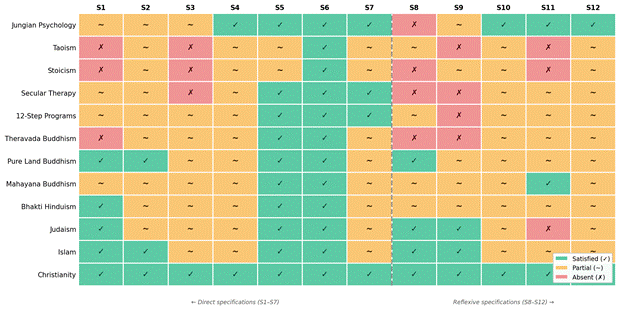
Figure 1. Specification heatmap: 12 traditions × 12 specifications. Hover text removed for print; see Table 1 for full specification names.
6. Direct vs. Reflexive Specification Scores
The scatter plot below positions each tradition on two axes: total score across direct specifications (S1–S7, maximum 14) on the horizontal axis, and total score across reflexive specifications (S8–S12, maximum 10) on the vertical axis. Each tradition scores 0 (absent), 1 (partial), or 2 (satisfied) per specification.
Christianity is the sole tradition at the theoretical maximum (14, 10). Islam, Jungian Psychology, and Pure Land Buddhism cluster at high direct scores (11) with diverging reflexive scores — a distribution that reflects their differing positions on Specifications 9 and 11. Stoicism and Taoism occupy the lower-left quadrant, failing on external agency from the direct specifications onward.
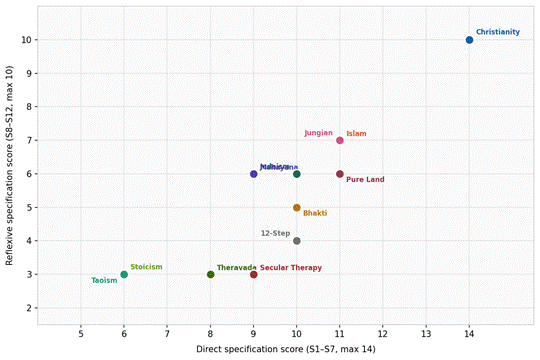
Figure 2. Scatter plot: direct specification score (x-axis, max 14) vs. reflexive specification score (y-axis, max 10). Each point represents one tradition.
7. Scoring Methodology
Scores are derived from the paper’s qualitative analysis and the convergence tables. Each specification is rated for each tradition on a 0–2 scale:
2 (Satisfied): The tradition explicitly and structurally addresses the specification.
1 (Partial): The tradition addresses the specification implicitly, variably, or incompletely.
0 (Absent): The tradition does not address the specification, or its structure is inconsistent with it.
Scores are interpretive and based on each tradition’s structural core rather than any particular school or expression within it. The paper’s Section 7.4 notes that internal variation within Christianity, and within other traditions, produces tension with several specifications. The charts represent the tradition at the level of analysis used in the paper.
Reference
Habecker. (2026). Convergent Derivation: A Three-System AI Experiment in Philosophical Stress-Testing. Unpublished manuscript.

