(c) Habecker | 2026
Abstract
This paper revisits and restructures the Thermodynamic Laws of Human Systems (TLHS) framework introduced in Habecker (2026). The original framework transposed four thermodynamic laws into principles governing human systems and derived twelve restoration specifications from them, using convergence across three independent AI systems as evidence of the derivations’ robustness. Critical analysis of the four original laws reveals significant variation in transposition fidelity: two laws hold genuine structural parallels with thermodynamic principles, while two others substitute philosophical claims for physical content without inheriting the physical structure. This paper proposes a reduced two-law framework — an entropy analog and a self-restoration impossibility principle — from which six specifications for complete restoration can be strictly and exhaustively derived.
The comparative religious analysis conducted under this reduced framework produces conclusions identical to those of the twelve-specification framework. The novel-state endpoint continues to function as the primary structural discriminator across traditions, and Christianity remains the sole tradition satisfying all six specifications at its structural core. The stability of this conclusion under aggressive reduction of the premises is identified as a stronger methodological finding than the AI convergence reported in the original paper: a conclusion that survives parsimony pressure is harder to attribute to the designer’s choices than one requiring the full complexity of its original structure to generate.
The paper concludes by distinguishing robustness from circularity — which can look similar from the outside — and proposing what a genuine falsification test would require.
Keywords: thermodynamics, entropy, human systems, parsimony, restoration specifications, comparative religion, philosophical methodology, robustness testing
1. Introduction
The question of how to stress-test a philosophical framework — to determine whether its conclusions follow necessarily from its premises or from the assumptions of the person who constructed them — is both important and methodologically underexplored. Habecker (2026) proposed one answer: provide the framework’s premises to multiple independent large language model systems and examine whether they converge on the same conclusions. Where they do, convergence constitutes evidence that the derivation is robust.
This paper proposes a different and more demanding test: reduction. If a framework’s conclusions remain stable when its premises are stripped to the minimum defensible set, that stability is evidence of a different kind — not that independent reasoners arrive at the same destination from the same starting point, but that the conclusions survive the removal of scaffolding that was not strictly necessary to reach them. A conclusion that holds under aggressive parsimony is harder to attribute to the specific choices of the framework’s designer than one requiring the full complexity of the original structure to generate it.
The occasion for applying this test is the TLHS framework itself. On examination, the original four-law structure contains transpositions of significantly uneven quality. Two laws hold genuine structural parallels with the thermodynamic principles they claim to transpose. Two others substitute philosophical claims for physical content, borrowing thermodynamic authority without inheriting thermodynamic structure. This unevenness does not make the conclusions false, but it does make them less secure: a conclusion resting partly on poorly grounded premises inherits those premises’ vulnerability to challenge.
This paper proceeds in five stages. Section 2 examines each of the four original laws for transposition fidelity. Section 3 proposes a two-law reduction and justifies it. Section 4 derives, strictly and without importing additional assumptions, the six specifications that follow from the two retained laws. Section 5 applies the reduced framework to the same comparative religious analysis conducted in the original paper. Section 6 addresses the stability finding and distinguishes it from the convergence finding. Section 7 engages the circularity question directly.
2. Critique of the Four-Law Framework
2.1 Law Two (Entropy) — Warranted
The strongest transposition in the original framework is the entropy law: human systems tend spontaneously toward disorder in the absence of sustaining input; disorder requires no cause but order does. This maps genuinely onto the thermodynamic second law, which holds that the entropy of an isolated system tends to increase spontaneously, and that decreasing entropy requires work input from outside. The TLHS version captures the same directionality — decline is default, maintenance is active — and the same asymmetry between order and disorder.
The primary qualification is that the second law applies with full rigor to isolated systems, and human beings are radically open systems, continuously exchanging energy, information, and relationship with their environment. Biology exists precisely because local decreases in entropy are possible in open systems. The transposition therefore holds the directionality and effort-requirement of the second law while loosening its strict domain conditions. This is a legitimate and manageable qualification, not a disqualifying one. The entropy law is retained.
2.2 Self-Restoration Impossibility — Warranted as Derived Consequence
The claim that a system cannot generate within itself the resources necessary to reverse its accumulated disorder is not — as the original framework presents it — an analog of the third law of thermodynamics. The actual third law addresses entropy behavior as temperature approaches absolute zero: it establishes the reference point for absolute entropy measurement and explains why absolute zero is unreachable. It says nothing about restoration or self-repair.
The self-restoration impossibility claim is better understood as a derived consequence of the entropy law. If disorder accumulates over time and reversing it requires work input, then a system expending its available resources on self-restoration is drawing from a depleting fund to address a compounding deficit. Complete self-restoration is structurally impossible not because of a separate thermodynamic law, but because the entropy law applied recursively to the restoration process itself generates that impossibility.
This principle is sufficiently non-obvious and sufficiently important to the framework’s analytical work to warrant separate statement as a second law rather than a corollary footnote. Its derived status is acknowledged; its structural significance justifies its position in the framework.
2.3 Law Zero (Non-Neutrality) — Not Warranted
The zeroth law of thermodynamics establishes the transitivity of thermal equilibrium: if system A is in equilibrium with B, and B with C, then A is in equilibrium with C. This is the formal basis for temperature as a measurable, comparable quantity. Its entire content is this transitivity relation. It says nothing about neutrality, inaction, or downstream consequences.
The TLHS Law Zero — that no neutral state exists and inaction carries consequences — abandons the zeroth law’s content entirely and substitutes a philosophical claim. It is not a transposition; it is a replacement occupying the zeroth position in the sequence without inheriting any of the zeroth law’s structure.
A gravitational analogy has been proposed as an alternative grounding: gravity is omnipresent and directional; there is no location in a gravitational field that is simply unaffected; remaining stationary requires active counterforce. This maps more naturally onto the non-neutrality claim than the zeroth law does, and represents a genuine structural insight. However, gravity is a force with a specific mathematical form, a defined source mass, and an inverse-square relationship. The claim that all dimensions of human experience operate like a gravitational field is a much larger assertion than the physical analogy can support.
Crucially, everything analytically useful in Law Zero is already implied by the entropy law: if systems tend toward disorder without active input, then inaction is itself a state with entropic consequences. Law Zero is therefore redundant rather than wrong. Its removal loses nothing the framework requires.
2.4 Law One (Accumulation) — Partially Warranted, Partially Imported
The first law of thermodynamics states that energy is conserved — it cannot be created or destroyed, only transformed. The TLHS analog, that consequences persist and compound, captures the conservation aspect: effects do not simply vanish. This is the warranted component, and it is genuine.
The compounding and exponential dynamics claim, however, goes beyond what energy conservation implies. Compounding behavior emerges from feedback loops and nonlinear system dynamics — it belongs to complexity theory and dynamical systems science rather than to thermodynamics proper. The accumulation law is therefore a hybrid: a legitimate thermodynamic analog joined to an imported empirical claim from a different field.
The conservation claim is already implied by the entropy law, which requires that accumulated disorder be addressed rather than merely present disorder. The compounding dynamic is a real and potentially important feature of human systems, but it belongs in the framework’s empirical assumptions rather than its thermodynamic foundations. Law One is therefore partially redundant and partially ungrounded. It is dropped.
3. The Two-Law Reduction
The critique in Section 2 yields two warranted principles. They are presented in Table 1 with their thermodynamic basis and the qualifications that apply to the transposition.
| Law | Thermodynamic Basis | |
| A | Human systems tend spontaneously toward disorder in the absence of sustaining input. Disorder is the default; order requires active maintenance. This tendency does not cease when restoration is attempted. | Second law of thermodynamics: entropy of isolated systems increases spontaneously. Decreasing entropy requires work input. Qualified limitation: humans are open systems; the directionality and effort-requirement hold even if the strict isolation condition does not. |
| B | A system cannot generate within itself the resources sufficient to fully reverse its accumulated disorder. Restoration requires external input of sufficient magnitude. | Derived from Law A applied reflexively: the resources available for self-restoration are subject to the same entropic depletion as the rest of the system. Not an analog of the third law, which concerns entropy near absolute zero. |
Table 1. The two retained laws with thermodynamic basis and transposition qualifications.
These two laws are not claimed to be thermodynamic laws in the strict physical sense. They are structural principles — holding for systems that satisfy their conditions — for which classical thermodynamics provides the clearest and most rigorously developed formal analog. The transposition is analogical rather than literal, but the analogy is genuine rather than merely rhetorical.
One further clarification: the two laws do not independently address the same things. Law A establishes the directionality of systems in the absence of input. Law B establishes the impossibility of the system supplying that input to itself. Both are required. A system for which only Law A held would be disordered but potentially self-repairing. A system for which only Law B held would be unable to self-restore but might not need restoration. The conjunction of the two laws is what generates the restoration problem and motivates the specification set.
4. Six Specifications Derived
The following specifications are derived strictly from Laws A and B without importing additional premises. Each specification is shown with its derivation path and the law or laws from which it follows. The list is claimed to be both necessary and sufficient: each specification is required by the laws, and the six together constitute the complete set that can be derived from them without additional assumptions.
| # | Specification | Derivation | Source Law |
| 1 | The restorative input must originate outside the system. | From Law B directly: the system cannot generate its own restorative resources. | Law B |
| 2 | The restorative input must be sustained, not one-time. | From Law A: the tendency toward disorder does not cease during restoration. Single interventions do not resolve the underlying dynamic. | Law A |
| 3 | The magnitude of restorative input must be proportional to accumulated disorder, not present state. | From Law A: disorder compounding over time is encoded in present structure. Addressing only present state leaves the causal history unaddressed. | Law A |
| 4 | The standard of sufficient restoration must be defined from outside the system. | From Law B applied to the system’s measurement capacity: a disordered system’s internal measures are products of its disorder and cannot reliably define sufficiency. | Laws A + B |
| 5 | The restored state must be novel rather than a return to the original state. | From Laws A and B together: Law A encodes disorder history irreversibly into structure; Law B rules out perfect reversal. The endpoint cannot be the original state. | Laws A + B |
| 6 | The restorative agent must be exempt from or inexhaustible relative to the same entropic constraints as the system being restored. | From Law A applied to the agent: an agent subject to the same depletion will fail to sustain the input Spec 2 requires. | Law A (applied to agent) |
Table 2. Six specifications for complete restoration, with strict derivations from Laws A and B.
Several features of this list warrant emphasis.
Specifications 1 through 3 follow from the laws individually and are relatively straightforward. They establish what any restoration attempt must provide: external input of sufficient magnitude, sustained over time. Most traditions that posit any form of transcendent or external restorative agency will satisfy these three without difficulty. They are necessary but not discriminating.
Specifications 4 and 5 require both laws in combination and represent the framework’s analytically distinctive contributions. Specification 4 — the external standard of sufficiency — applies Law B’s logic to the epistemic function of the disordered system: just as the system cannot generate its own restoration resources, it cannot reliably measure its own state of restoration. The instrument is broken; the reading it produces is untrustworthy. Specification 5 — the novel-state endpoint — applies both laws to the question of what restoration looks like when complete: since Law A encodes disorder history into the system’s structure and Law B rules out perfect reversal, the restored state cannot be the original state. It must be something genuinely new.
Specification 6 applies Law A to the restorative agent itself rather than to the system being restored. This is the reflexive move whose significance was recognized in the original paper. The logic is simple but the implication is significant: if Law A is universal, it applies to the agent performing restoration just as it applies to the system receiving it. An agent subject to the same depletion it is working against will eventually fail to sustain the input Specification 2 requires. The restorative agent must therefore operate outside the same constraints — not merely be more capable, but categorically exempt from or inexhaustible relative to them.
5. Comparative Analysis
5.1 Scoring Matrix
The twelve traditions examined in Habecker (2026) are scored against the six specifications using the same 0-1-2 scale: 2 (satisfied), 1 (partial or variable), 0 (absent or structurally contradicted). Scores reflect each tradition at its structural core as represented in its dominant expressions, not at its margins. Table 3 presents the complete scoring matrix; Figures 1 and 2 present the data visually.
| Tradition | S1 | S2 | S3 | S4 | S5 | S6 | Total % |
| Christianity | ✓ | ✓ | ✓ | ✓ | ✓ | ✓ | 100% |
| Islam | ✓ | ✓ | ✓ | ✓ | ~ | ✓ | 92% |
| Judaism | ✓ | ✓ | ✓ | ~ | ✗ | ✓ | 75% |
| Bhakti Hinduism | ✓ | ✓ | ~ | ~ | ~ | ~ | 67% |
| Mahayana Buddhism | ~ | ✓ | ~ | ~ | ~ | ✗ | 50% |
| Pure Land Buddhism | ✓ | ✓ | ~ | ~ | ~ | ✓ | 75% |
| Theravada Buddhism | ✗ | ✓ | ~ | ✗ | ~ | ✗ | 33% |
| 12-Step Programs | ~ | ✓ | ~ | ✗ | ~ | ~ | 50% |
| Secular Therapy | ~ | ✓ | ✓ | ✗ | ~ | ✗ | 50% |
| Stoicism | ✗ | ✓ | ~ | ✗ | ✗ | ✗ | 25% |
| Taoism | ✗ | ✓ | ~ | ✗ | ✗ | ~ | 33% |
| Jungian Psychology | ~ | ✓ | ✓ | ✗ | ✓ | ✗ | 58% |
Table 3. Scoring matrix: 12 traditions × 6 specifications. S1–S3 are foundational; S4–S6 are discriminating.
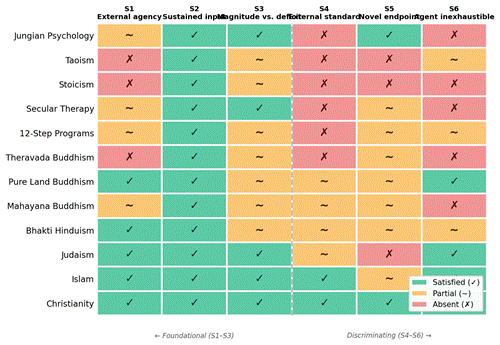
Figure 1. Specification heatmap. Green = satisfied, amber = partial, red = absent. Dashed line separates foundational from discriminating specifications.
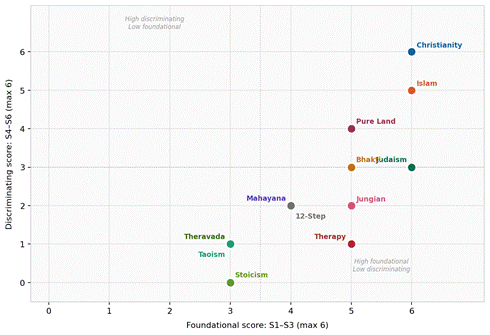
Figure 2. Scatter plot: foundational score (S1–S3, x-axis, max 6) vs. discriminating score (S4–S6, y-axis, max 6). Christianity is the sole tradition at the theoretical maximum (6, 6).
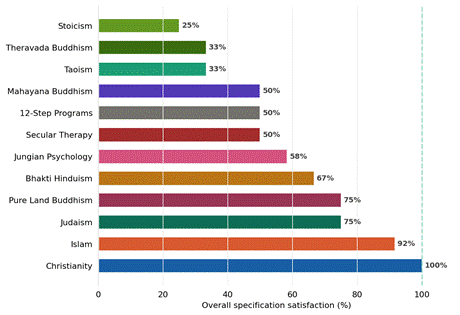
Figure 3. Overall specification satisfaction by tradition (%), sorted descending.
5.2 Foundational Specifications: The Sorting Function of S1–S3
Specifications 1 through 3 perform a preliminary sorting function rather than a discriminating one. Traditions with genuinely external restorative agency — Christianity, Islam, Judaism, Pure Land Buddhism, Bhakti Hinduism — all score fully on Specification 1. Traditions that locate the restorative work within the system itself — Theravada Buddhism, Stoicism, Taoism — fail Specification 1 immediately and score poorly across the board regardless of how they perform on the remaining specifications.
The partial scores on Specification 1 for traditions like Jungian psychology, 12-Step programs, and secular therapy reflect a genuine structural ambiguity: these traditions posit external relationships or influences but not external agency in the strong sense the specification requires. The therapist, sponsor, or collective unconscious is external to the individual but remains within the human system broadly construed, and is subject to the same entropic constraints Specification 6 will address.
Specification 3 — magnitude proportional to accumulated deficit — produces the most interesting differentiation within the foundational set. Secular therapy scores surprisingly well here, because good therapeutic practice explicitly attends to developmental history and accumulated trauma rather than merely presenting symptoms. This is one of secular therapy’s genuine structural strengths relative to the specification set, and it should be acknowledged rather than minimized.
5.3 Discriminating Specifications: Where the Framework’s Analytical Force Concentrates
The discriminating specifications — 4, 5, and 6 — do the framework’s primary analytical work. Their combined effect is to distinguish traditions that satisfy the foundational requirements from those that satisfy all six.
Specification 4, the external standard of sufficiency, eliminates or significantly reduces the scores of traditions that allow the system being restored to participate in defining the criteria for its own restoration. Secular therapy fails here entirely: the definition of therapeutic sufficiency is set by a combination of professional consensus and client self-report, both of which are internal to the human system. Jungian psychology fails here for the same reason — individuation is measured by the analysand’s own process, however richly theorized. 12-Step programs fail because the program itself, however wisdom-laden, sets the standard through its own structure rather than by reference to an external authority that transcends the human system.
The Abrahamic traditions — Christianity, Islam, Judaism — all score well on Specification 4, because all three posit a divine standard that is not subject to human negotiation. The differences among them concentrate on Specification 5.
Specification 5 is the primary discriminator. The near-universal human intuition that restoration means recovery — return to a prior state of health, harmony, or innocence — is precisely what the combined force of Laws A and B identifies as structurally unavailable. A restored state that carries the encoded history of its own disorder cannot literally be the original state. This is not a preference but a necessity generated by the premises.
Islam’s soteriological goal is substantially framed as restoration to fitrah, the original pure nature in which human beings are created. Paradise carries imagery of a recovered garden, a return to what was lost. This framing satisfies Specifications 1 through 4 but sits in direct tension with Specification 5. The return orientation is not peripheral to Islamic soteriology but structurally central to it.
Judaism’s primary restorative mechanism — teshuvah — means return. The word itself names the tradition’s account of restoration as a movement back toward a prior covenantal relationship. As with Islam, this is not a marginal feature but a structural one. Specification 5 is not merely absent from Judaism but actively reversed by the tradition’s central concept.
Christianity’s new creation framework — particularly the Pauline formulation that if anyone is in Christ, the old has passed away and the new has come — explicitly frames the soteriological endpoint as something categorically beyond the original state rather than a recovery of it. The resurrected body, in Christian theology, bears the marks of its history while being genuinely and categorically new. This is not a recovery. It is a transformation into something the system has never been. Specification 5 is not merely satisfied; it is the tradition’s own explicit theological commitment.
Specification 6 eliminates traditions whose restorative agent is subject to the same constraints as the system being restored. This removes secular therapy and Jungian psychology at the agent level, regardless of their partial strengths elsewhere. It also limits Mahayana Buddhism: the bodhisattva functions as a quasi-external restorative presence but is itself operating within the karmic structure that governs the system being restored. An agent within the same constraining system cannot be exempt from it.
Pure Land Buddhism is the most interesting near-miss. Amitabha’s merit is described as infinite and available to those who cannot accumulate sufficient merit themselves — a genuine analog of the inexhaustibility requirement. The tradition partially satisfies Specification 5 in that rebirth in the Pure Land is a genuine transformation rather than simple return. But the ultimate endpoint — liberation, nirvana — is shared with the broader Buddhist framework and the tradition does not clearly supply an external standard of sufficiency (Specification 4) in the way the Abrahamic traditions do.
5.4 Summary
The comparative analysis under six specifications produces the same structural result as the analysis under twelve. Christianity satisfies all six specifications at its structural core. The Abrahamic traditions form a cluster distinguished from other theistic traditions by their external agency and external standard, with Islam and Judaism diverging from Christianity primarily on Specification 5. Non-theistic traditions fail at Specifications 1 and 6. Secular frameworks with good scores on foundational specifications fail consistently at Specification 4. The primary discriminator is Specification 5 — the novel-state requirement — which is both the most counterintuitive specification and the most structurally necessary one.
6. Stability Under Reduction: What the Convergence Demonstrates
The original paper’s primary methodological claim was that convergence across three independent AI systems constitutes evidence of the derivation’s robustness. That claim is real but limited. Three large language models trained on partially overlapping corpora are not fully independent reasoners, and their convergence may partly reflect shared patterns in the training data rather than purely independent logical derivation.
This paper demonstrates something different and stronger: the framework’s conclusions are stable under reduction of the premises. Table 4 presents the comparison.
| Dimension | Original (12-spec) | Reduced (6-spec) | Change |
| Laws used | 4 (Zero, One, Two, Three) | 2 (Entropy, Self-Restoration) | 2 laws dropped |
| Transposition fidelity | Uneven: 2 strong, 2 weak | Both warranted | Eliminated ungrounded premises |
| Specifications derived | 12 | 6 | 6 dropped (implied or imported) |
| Derivation method | Mixed: some strict, some imported | Strict throughout | All specs trace to named law |
| Primary discriminator | Spec 11: novel state | Spec 5: novel endpoint | Identical content |
| Comparative top ranking | Christianity (all 3 AI systems) | Christianity | Identical |
| Secondary pattern | Abrahamic traditions cluster | Abrahamic traditions cluster | Identical |
| Key structural failure | Return framing (Islam, Judaism) | Return framing (Islam, Judaism) | Identical |
Table 4. Comparison of original twelve-specification framework and reduced six-specification framework across key dimensions.
The stability finding is significant for the following reason. If the twelve-specification framework were producing its results because of the particular choices made in constructing it — four laws rather than two, twelve specifications rather than six, the specific framing of reflexive specifications — then stripping those choices away should change the results. It does not. The same comparative conclusion emerges from fewer premises and fewer specifications, with each premise more carefully justified and each specification more strictly derived.
This is the methodological contribution the original paper was reaching for but did not fully achieve. The convergence finding says: multiple reasoners reached the same place from the same starting point. The stability finding says: the same place is reached from a smaller starting point. The latter is the harder finding to explain away, because it eliminates the hypothesis that the conclusion is an artifact of a particular analytical architecture.
Stability under parsimony does not establish that the conclusions are true. It establishes that they are structurally necessary given the premises — and that they do not depend on excess scaffolding to generate. This is what makes them worth taking seriously rather than dismissing as conclusions engineered toward a predetermined end.
7. The Circularity Question
An honest reckoning with the framework requires confronting the question that robustness cannot answer: the possibility that the laws were constructed with the conclusion already in view. Robustness and circularity can look similar from the outside. Both produce stable conclusions. Both survive stress-testing within the framework’s own terms. What distinguishes them is not the conclusion’s consistency with the premises, but the independence of the premises from the conclusion they generate.
The concern is specific. Laws A and B, as stated, might have been constructed — perhaps not consciously — to select for a particular kind of restoration: one requiring external agency, sustained input, inexhaustible restorative force, and a novel rather than recovered endpoint. If the laws were designed to generate those specifications, and the specifications were designed to match a particular tradition, then the convergence is not evidence but engineering.
Two things can be simultaneously true here: the framework can have been constructed by someone with theological commitments, and the conclusions can nonetheless be structurally well-grounded. These are not mutually exclusive. The question is not whether the author has commitments — everyone does — but whether the analytical structure stands independently of them.
The test that has not been run is the one that would most clearly distinguish robustness from circularity: constructing a genuinely different starting framework — different laws, different premises, not derived from thermodynamics — and examining whether it produces different comparative results. If every reasonable framework for thinking about human disorder and restoration converges on the same comparative conclusions, that convergence is much harder to explain by circularity than convergence within a single framework’s terms. If a different framework produces different results, the circularity hypothesis gains force.
What would falsification look like within this framework? A tradition would need to satisfy all six specifications without the novel-state endpoint, which would require the laws to generate different necessary conditions than they currently do. Alternatively, a tradition would need to satisfy Specification 5 — the novel endpoint — while failing Specifications 1 or 6, which would require the external agency and inexhaustibility requirements to be separable from the novelty requirement in a way the current analysis suggests they are not. The framework is falsifiable in principle, even if the falsifying case has not yet been identified.
This is where the paper’s honest limits lie. The analysis demonstrates structural correspondence between the framework’s derived specifications and Christianity’s theological architecture. It demonstrates that this correspondence is stable under parsimony pressure. It does not demonstrate, and cannot demonstrate within its own terms, that the framework was not constructed to produce this result. That question requires external testing of a kind this paper does not provide.
8. Conclusions
This paper has proposed a two-law reduction of the Thermodynamic Laws of Human Systems framework and derived, strictly and without importing additional assumptions, six specifications for complete systemic restoration. The comparative analysis conducted under this reduced framework produces conclusions identical to those of the original twelve-specification analysis: Christianity is the sole tradition satisfying all six specifications at its structural core, with the novel-state endpoint functioning as the primary discriminator across traditions.
The stability of this conclusion under aggressive reduction is identified as the paper’s primary methodological finding. It is a stronger result than the AI convergence reported in the original paper, because it demonstrates that the conclusions do not depend on the specific analytical architecture that generated them in their original form. They survive the removal of two laws and six specifications without changing.
Three contributions are offered. First, a methodology for evaluating transposition fidelity in frameworks that borrow structure from the natural sciences — not every such borrowing is equally warranted, and the unevenness matters for the conclusions’ security. Second, a parsimony-stability test for philosophical frameworks, proposed as complementary to and more demanding than convergence-based stress-testing. Third, an honest engagement with the circularity question that convergence testing cannot resolve, and a specification of what external testing would be required to address it.
The framework continues to make no claims about the theological truth of any tradition. What it demonstrates, with greater parsimony and therefore greater structural security than its predecessor, is that the problem of human disorder and restoration — stated in terms derived from the most general principles of thermodynamic analogy — selects structurally for a particular kind of solution. Whether that selection reflects something real about human systems, or something about how the selection criteria were constructed, remains the question the framework cannot answer from within its own terms.
References
Boltzmann, L. (1877). Über die Beziehung zwischen dem zweiten Hauptsatze der mechanischen Wärmetheorie und der Wahrscheinlichkeitsrechnung. Wiener Berichte, 76, 373–435.
Clausius, R. (1850). Über die bewegende Kraft der Wärme. Annalen der Physik, 155(3), 368–397.
Habecker. (2026). Convergent Derivation: A Three-System AI Experiment in Philosophical Stress-Testing. Unpublished manuscript.
Habecker. (2026). Thermodynamic Laws of Human Systems: A Framework for Understanding Entropy, Accumulation, and Restoration in Human Experience. Unpublished manuscript.
Kelvin, W. T. (1851). On the dynamical theory of heat. Transactions of the Royal Society of Edinburgh, 20, 261–268.
 Moral Architecture Thought Experiments