Matthew J. Habecker, MS, CPO
Independent Scholar • Indianapolis, Indiana
moralarchitecture.com
©March 2026
Part of the Pattern Framework Series
This paper extends and complements:
The Architecture of Moral Reality (Habecker, 2026a)
Curvature and Consequence (Habecker, 2026b)
The Dimensions of the Intervention (Habecker, 2026c)
Abstract
This paper develops two epistemological extensions of the Habecker Framework of Moral Thermodynamics, arising from observations made during a hike above Jordanelle Reservoir near Park City, Utah, in March 2026. Both extensions address the same question from different angles: what does it mean to perceive the pattern that the framework describes, and why do some observers see it while others, examining the same evidence, do not?
The first extension develops the stereoscopic vision model of faith. Stereoscopic depth perception is not merely enhanced monocular vision — it is a qualitatively different category of information that is structurally unavailable to either eye operating alone. Depth emerges only from the convergence of two offset fields. This paper argues that faith, properly understood, is not belief in the absence of evidence but the alignment of the observer’s receptive field with the incoming signal — an alignment that makes available a category of perception that the single-field observer cannot access regardless of how carefully they examine the same evidence. The argument has direct implications for why the seven-stage case presented in The Architecture of Moral Reality can be followed with full comprehension and still not compel assent: the information is present; the resolution requires convergence.
The second extension develops the Jordanelle Path Argument: a direct observation from the hike that constitutes, in miniature, a rigorous case against the coincidence interpretation of patterned low-entropy structures. The abandoned highway above Jordanelle Reservoir is randomly reclaimed by vegetation across most of its surface — high entropy, disordered, no preferred axis. Running straight through the center is a cleared path extending to the visible horizon. The path was not made by the highway’s designers. It emerged from the repeated independent passage of subsequent travelers converging on the same line. This paper argues that the information-theoretic structure of this observation — a low-entropy signal emerging from a high-entropy background through the convergent action of independent agents — is formally identical to the consilience argument that anchors Stage Six of the framework. The coincidence interpretation fails in both cases for the same reason: it requires a low-entropy structure to have arisen spontaneously from a high-entropy background, which is a direct violation of the Second Law.
The paper concludes with a third observation specific to Jordanelle: the path leads toward Keetley, a town that is real, was once fully inhabited, and now lies submerged beneath the reservoir. The destination is invisible from the surface but present beneath it. The path on the abandoned highway is the last visible remnant of the route that once connected travelers to that place. This is not illustration. It is the thermodynamic and theological structure of the framework, encountered unexpectedly in physical geography.
I. The Jordanelle Path: A Field Observation in Information Theory
1.1 The Observation
The photograph in Figure 1 was taken on an abandoned highway above Jordanelle Reservoir in Utah during a hike in March 2026. The image requires description before analysis, because the description is the argument.
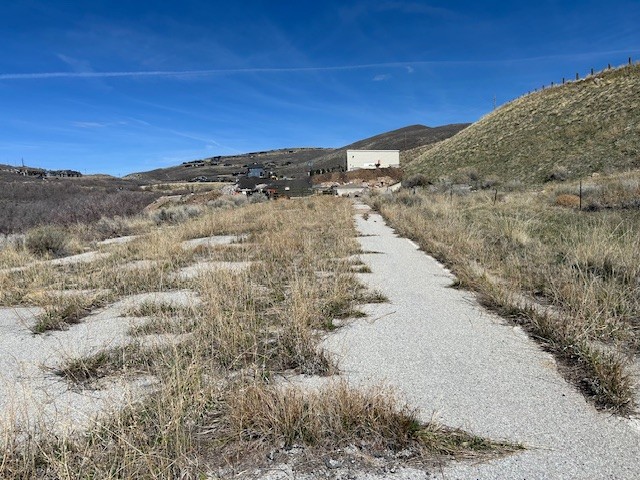
Figure 1. Abandoned highway above Jordanelle Reservoir, Utah, March 2026. The path runs straight through randomly distributed vegetation toward a submerged destination. The cleared line was not made by the highway’s designers. It emerged from the repeated independent passage of subsequent travelers converging on the same route.
The pavement is old, cracked, and reclaimed. Across its full width, vegetation has established itself — dried grasses, sage, low brush — distributed with no preferred axis, no directional pattern, no organizing principle beyond opportunistic root establishment in pavement cracks. The distribution is, in information-theoretic terms, high entropy: disordered, random, without signal.
Running through the center of the pavement, extending from the immediate foreground to the visible horizon, is a cleared path. The path is not paved differently. It is not marked. It is not separated from the surrounding vegetation by any physical barrier. It is simply clear, where the surrounding pavement is not — a low-entropy linear structure running straight through a high-entropy background, pointing toward the horizon with the precision of a compass bearing.
The path was not made by the highway’s designers. The highway was abandoned. The path emerged afterward, from the repeated passage of hikers who independently chose the same line through the available terrain. No coordination occurred. No map was consulted. Independent agents, responding to the same underlying logic of available passage, converged on the same route and cleared it by their convergence.
1.2 The Information-Theoretic Analysis
Shannon entropy provides the formal framework for analyzing what the photograph shows. In Shannon’s formulation, the entropy of a probability distribution measures its disorder: high entropy corresponds to maximum unpredictability, low entropy to structured, patterned information. A random distribution of vegetation across a pavement surface is high entropy. A straight cleared path through that distribution is low entropy — it contains information, which is to say it is structured in a way that requires explanation.
The Second Law of thermodynamics states that entropy in a closed system increases spontaneously. Low-entropy structures do not arise from high-entropy backgrounds without a cause. This is not a probabilistic statement in the ordinary sense — it is not merely unlikely that a cleared path would appear spontaneously in randomly distributed vegetation. It is thermodynamically prohibited. The probability is not small. It is, for all practical purposes under any reasonable statistical model, zero.
The cleared path therefore requires a cause. That cause is not mysterious: it is the repeated passage of agents with intention and direction, converging independently on the same line. The low-entropy structure is the physical trace of convergent intentional agency operating over time.
A skeptic might object: perhaps the path cleared by chance, through random variation in vegetation density or drainage patterns in the pavement. This objection fails on examination. A random or drainage-driven clearing would produce an irregular, meandering, non-directional pattern — a reduction in local vegetation density without preferred axis. What the photograph shows is directional, linear, and horizon-pointing: a structure whose informational content is precisely what convergent intentional passage would produce and precisely what random processes would not.
1.3 The Formal Parallel to the Consilience Argument
The Jordanelle Path observation is not merely analogous to the consilience argument in Stage Six of The Architecture of Moral Reality. It is formally identical to it in structure.
The consilience argument identifies three independent formal systems — general relativity, quantum mechanics, and the Habecker Framework — that were developed by different investigators for different purposes in different domains, and that independently arrive at structurally identical conclusions: that the system requires external specification at measure-zero boundary events, that the internal dynamics are complete but not self-sufficient, and that the boundary architecture has specific properties the internal formalism cannot generate.
The probability that this convergence is coincidental decreases with each additional independent line of evidence. Three independent formal systems arriving at the same structural boundary is, by the same information-theoretic reasoning that applies to the path, a low-entropy structure in a high-entropy background. It requires a cause. The coincidence interpretation requires the spontaneous emergence of a structured, directional, horizon-pointing signal from a random distribution of independent intellectual efforts. That is the same error as calling the cleared path a coincidence.
In both cases, the formal structure of the argument is:
- A high-entropy background exists: random vegetation on abandoned pavement; independent formal systems developed in unrelated domains.
- A low-entropy signal emerges: a straight cleared path pointing toward a horizon; a shared boundary architecture pointing toward the same structural requirement.
- The signal has the precise structure that convergent intentional agency would produce and that random processes would not.
- The coincidence interpretation requires spontaneous low-entropy emergence from a high-entropy background: a Second Law violation.
- The causal interpretation — convergent intentional agency operating toward a real destination — is thermodynamically coherent and informationally sufficient.
The argument is the same argument. The hike made it visible in physical form.
1.4 The Skeptic’s Available Responses
A rigorous scientific skeptic has three available responses to the Jordanelle Path Argument as applied to the consilience case. Each is examined in turn.
Response One: The convergence is not genuine — the systems do not actually share the same boundary architecture.
This is the strongest possible response and the one the framework takes most seriously. It can be evaluated empirically. The Architecture of Moral Reality presents the structural identity claim in detail across Stage Six: that GR, QM, and the Habecker Framework each independently predict internal completeness combined with external dependence at measure-zero boundary events. A skeptic who contests this claim must identify a specific disanalogy — a point at which the three systems’ boundary architectures are structurally different rather than identical. This is a tractable intellectual task. The framework invites it.
Response Two: The convergence is genuine but coincidental.
This response accepts the observation and contests its significance. It is formally equivalent to accepting that the path in the photograph is cleared in a straight line to the horizon and then claiming this occurred by chance. The information-theoretic analysis applies directly: the probability of three independent formal systems converging on the same boundary architecture by chance is calculable in principle and vanishingly small in practice. The skeptic who takes this position must either provide a probability estimate that is non-negligible or accept that the coincidence interpretation is not a serious scientific response.
Response Three: The convergence is real and significant, but points toward a different explanation than the framework proposes.
This is the most intellectually serious response and the one the framework most wants to engage. It accepts the observation, accepts its informational significance, and contests the specific identification of the cause. A skeptic who takes this position is not dismissing the framework — they are engaging it at the level of rigor it requires. The framework’s answer is Stage Seven: the ten-point restoration specification derived entirely from the structure of the consequence network, which a skeptic in this position must show is matched by an alternative candidate with equal or greater precision. The framework holds this challenge open.
II. The Submerged Destination: Keetley and the Invisible Real
2.1 What Lies Beneath the Water
The path in the photograph does not lead to an empty horizon. It leads toward Keetley — a town that was real, was inhabited, had streets and structures and the accumulated consequence of human lives lived within it, and that now lies beneath the surface of Jordanelle Reservoir. The reservoir was filled in the early 1990s. The residents were relocated before the water came. The town did not cease to exist. It was covered.
This detail is not decorative. It changes the informational content of the photograph in a way that is directly relevant to the framework’s central claims.
Without the Keetley context, the photograph shows a path pointing toward a horizon — a low-entropy signal in a high-entropy background, with an implied destination beyond the frame. With the Keetley context, the photograph shows something more precise: a path pointing toward a real destination that is inaccessible by surface-level navigation, invisible to direct observation, but present beneath the surface of what has accumulated over it.
2.2 The Thermodynamic Reading
The framework’s Law One establishes that consequences accumulate and compound. The present state of any moral system is the integral of all prior displacements — not merely their sum but their compounded product, each consequence generating the conditions for subsequent consequences in a trajectory that deepens with time.
Jordanelle Reservoir is, in physical geography, exactly what Law One describes in moral thermodynamics: the accumulated consequence of a decision — the dam — that covered what was once accessible, ordered, and inhabited. The decision was not malicious. It was consequential. The water that covers Keetley did not appear spontaneously. It is the physical trace of accumulated prior choices, each individually manageable, whose aggregate effect was the permanent alteration of what is visible from the surface.
The pre-dam state — the accessible town, the inhabited valley, the road that led directly to Keetley — corresponds in the framework’s terms to the ordered state of the consequence network before entropy accumulated to its current level. That state was real. It is still real in the sense that the physical matter of Keetley has not been destroyed — it has been covered. The destination exists. It is simply inaccessible by the navigation methods available to a traveler on the surface.
2.3 The Relocated Residents
The residents of Keetley were not submerged with the town. Before the reservoir was filled, they were brought out — relocated, passage made for them before the covering came.
The framework does not press every detail of a physical observation into theological service mechanically. That would be the kind of pattern-forcing that the consilience methodology specifically guards against. But it also cannot ignore when a physical observation reproduces, in its specific details, the structural architecture that the framework independently derived from thermodynamic reasoning.
The ten-point restoration specification in The Architecture of Moral Reality identifies demonstrable reversal as a structural requirement: the restoration event must produce an observable state change distinguishable from the prior consequence accumulation. It must provide passage out before the full weight of accumulated consequence closes. The residents of Keetley were given exactly this: a path out, before the water came, that preserved what the accumulation would otherwise have covered permanently.
The framework notes the correspondence and lets the reader hold it. The bridge is made of math. What the reader does with the geography is their own crossing.
2.4 What the Surface Observer Cannot See
A traveler who stands at the edge of Jordanelle Reservoir and sees only water is not wrong about what they can see from the surface. The surface observation is accurate. Keetley is not visible from the surface. No amount of careful surface-level observation will reveal it. The observer who concludes from this that Keetley does not exist, or never existed, or that the path on the abandoned highway is therefore meaningless, has made a specific epistemological error: they have conflated the limits of surface-level observation with the limits of reality.
This is the error the framework identifies in the treatment of moral consequence by frameworks that deny its physical reality. The consequence is not visible from every vantage point. It does not announce itself loudly at every moment. The path on the surface is subtle — a cleared line through random vegetation, requiring attention to resolve. But the invisibility of the destination from a specific vantage point does not establish the nonexistence of the destination. It establishes only the limits of that vantage point.
The Habecker Principle, established in The Architecture of Moral Reality, closes this escape hatch at the physical level: moral consequence is not invisible because it is non-physical. It is nonzero in Tμν, real in the epigenetic record, measurable in the neural architecture of consequentially loaded individuals, documented in the social capital trajectories of communities under consequence accumulation. The destination is real. The path points to it. The water covers it. And the water itself is the product of accumulated prior choices, which is precisely what Law One predicts.
III. The Stereoscopic Model of Faith
3.1 The Problem of Non-Compulsion
The Architecture of Moral Reality presents a seven-stage argument proceeding from physical first principles to theological conclusion. Each stage is sequentially justified. The physics is accurate. The empirical support is documented. The logical structure is valid. And yet a careful, intelligent reader can follow the argument in its entirety, find no specific step to contest, and still not arrive at the conclusion as a lived reality.
This is not a failure of the argument. It is a structural feature of the domain the argument is describing — and the framework, applied consistently to itself, predicts it. The voluntariness requirement in the restoration specification is not incidental: the node event must be freely chosen, not coerced, because coercion generates new entropy rather than eliminating it. The same structure applies to the observer. An argument that compelled assent regardless of the observer’s receptive orientation would be a form of coercion. The framework predicts that complete resolution requires alignment that cannot be forced.
The question is what that alignment is, what it does, and why its absence leaves a specific kind of perceptual gap that no amount of additional argument can close.
3.2 The Physiology of Stereoscopic Vision
Stereoscopic depth perception is produced by the brain’s fusion of two slightly offset monocular images — one from each eye. Each eye delivers a complete, coherent, accurate image of the visual field. Neither image is defective. Neither is missing information that a more careful single-eye observation could recover. The two images are simply offset by the interpupillary distance — approximately 6.3 centimeters in the average adult — which means each eye sees the world from a slightly different angle.
The brain processes the disparity between these two images and extracts from it a third dimension: depth. Objects closer to the observer produce greater disparity between the two retinal images; objects farther away produce less. The brain converts this disparity map into the experience of three-dimensional space — the perception that objects are at specific distances, that some are in front of others, that the world has spatial structure extending away from the observer.
The critical feature of this system is that depth information is not present in either monocular image. It cannot be recovered from either image by any amount of careful analysis. It is not hidden in the image, waiting to be extracted by a sufficiently sophisticated algorithm. It is a relational property — it exists in the relationship between the two images, not in either image alone. A person with one eye covered sees a complete, accurate, detailed image of the world. They do not see depth. No correction to the single-eye image changes this. The information that produces depth perception is structurally absent from any single field of view.
3.3 The Model Applied
The seven-stage argument of The Architecture of Moral Reality is monocular. This is not a criticism. It is a structural description. The argument operates entirely within one field of view: the field of physics, biology, thermodynamics, and formal logic. Within that field, it delivers a complete, coherent, accurate image. It shows that moral acts are physically real, that the consequence field is thermodynamically constituted, that the Laws govern its behavior, that the restoration specification has ten precise requirements, that three independent formal systems converge on the same boundary architecture, and that the historical claims of Christianity match the independently derived specification with a precision not accountable by coincidence.
This image is real. It is not distorted or incomplete within its own field. A person who examines it carefully and finds no specific error to identify is seeing it accurately.
But depth — the full dimensionality of what the argument is pointing at — is a relational property. It exists in the relationship between the analytical field and a second field: the field of personal receptivity to the signal the analysis has identified. When these two fields are aligned — when the observer’s posture toward the incoming signal is one of genuine openness rather than analytical distance — the brain performs its fusion, the disparity is resolved, and depth emerges. The destination that was present in the argument as a logical conclusion becomes present as a spatial reality: something at a specific distance, in a specific direction, with specific properties that the monocular image described accurately but could not make three-dimensional.
Faith, on this model, is not the willingness to believe without evidence. It is not the suspension of analytical standards. It is not the second field replacing the first. It is the alignment of the second field with the first — the orientation of personal receptivity toward the signal the analysis has identified — that allows the depth information already present in the combined signal to resolve.
3.4 Diplopia: The Misalignment State
When the two eyes are misaligned — a condition called diplopia or double vision — the brain cannot perform stereoscopic fusion. Instead of a single three-dimensional image, the observer sees two separate images occupying the same visual field, competing rather than composing. The information from both eyes is present. The images are both real. The misalignment prevents the fusion that would produce depth.
This is the precise phenomenology of the observer who encounters the framework’s argument and finds two separate, competing pictures: the analytical case and the theological conclusion, present simultaneously but failing to compose into a single coherent three-dimensional image. The analytical field says the specifications are met. A separate field — perhaps prior commitment to naturalism, perhaps unresolved consequence load in the psychological dimension, perhaps the simple unfamiliarity of the posture that alignment requires — produces a competing image that prevents fusion.
The person experiencing diplopia is not wrong about what they see. Both images are real. The misalignment is not a moral failure. It is a perceptual condition that has a specific structural cause and, correspondingly, a specific structural resolution.
3.5 What Alignment Is Not
The stereoscopic model clarifies several common misunderstandings about faith that the framework needs to address directly, because a scientific skeptic will raise them.
Alignment is not credulity. Credulity is the acceptance of claims without evidence. The stereoscopic model explicitly requires that the first field — the analytical field — be intact and accurate. A person who has not examined the evidence cannot achieve stereoscopic resolution; they have no first image to fuse. The analytical work is not bypassed by faith. It is the prerequisite for the fusion that faith makes possible.
Alignment is not the replacement of evidence with feeling. The depth perception produced by stereoscopic fusion is not a feeling about the monocular image. It is additional real information extracted from the relationship between two real fields. The ‘feeling’ of standing in a three-dimensional world is not a subjective overlay on a flat image — it is the correct perception of a real three-dimensional world, made available by the fusion of two accurate fields. Similarly, the depth that becomes available through the alignment of analytical and receptive fields is not an emotional supplement to the logical argument. It is additional real information about the destination the argument has identified, made available by the convergence.
Alignment is not certainty. Stereoscopic vision does not resolve every question about what lies beyond the visible horizon. It establishes depth structure within the current field of view. The resolution the framework’s convergence produces is not omniscience about the destination. It is the correct perception of a real destination at a real distance in a real direction — one that the monocular analysis described accurately but could not make three-dimensional.
3.6 The Voluntariness Connection
The restoration specification in Stage Four of The Architecture of Moral Reality identifies voluntariness as a structural requirement: the node event must be freely chosen because coerced absorption generates new entropy rather than eliminating it. The voluntary structure is not incidental to the mechanism. It is constitutive of it.
The stereoscopic model shows why the same structure applies to the observer. Forced alignment — compelled receptivity — is not alignment in the relevant sense. The second field must be brought into orientation freely, by the observer’s own act, because the depth information that becomes available is a property of genuine convergence, not of external pressure applied to one field until it approximately matches the other.
An argument that produced assent regardless of the observer’s orientation would be, in the framework’s terms, a redistribution mechanism rather than a restoration mechanism. It would move the observer from one position to another by force, generating new entropy in the conscious dimension rather than opening the valve through which accumulated entropy can flow out voluntarily.
This is why the framework’s seven-stage argument ends where it ends. The bridge is real. The path is cleared. The destination is present beneath the surface. The argument has done what a monocular argument can do. The depth is available. The crossing is a choice.
IV. Synthesis: Three Observations, One Structure
4.1 The Convergence of the Hike’s Observations
The three observations from the Jordanelle hike — the cleared path through random vegetation, the submerged destination, and the stereoscopic model of faith — are not three separate insights that happen to be related. They are three aspects of the same structural observation, encountered from different angles on the same afternoon.
The cleared path demonstrates, in physical form, the information-theoretic argument against coincidence as an explanation for patterned low-entropy signals. It shows what convergent intentional agency looks like when it operates through a high-entropy medium over time: a straight line to the horizon, made by independent travelers who never coordinated, pointing toward a destination they could not fully see.
The submerged destination demonstrates, in physical geography, what the consequence accumulation described by Law One looks like when it reaches the scale of a community: a real, inhabited, structured place covered by the compounded weight of subsequent choices, invisible from the surface but present beneath it, accessible only to a traveler who knows it is there and has a path that predates the covering.
The stereoscopic model demonstrates why a traveler can stand at the edge of the reservoir, see the water accurately, follow the path on the abandoned highway accurately, and still not perceive the full dimensionality of what both observations are showing — and why no additional monocular information closes that gap.
Together, they describe the complete epistemological situation of the reader who has followed the seven-stage argument of The Architecture of Moral Reality: the path is cleared, the destination is real and present beneath what has accumulated over it, the argument is the monocular image, and the depth is available to the observer who brings both fields into alignment.
4.2 The Hardest Skeptical Objection
The framework must engage the hardest version of the skeptical objection, which is not “the path is coincidental” or “the destination doesn’t exist” but rather: “You are finding meaning in geography because you are already committed to finding it. The path, the submerged town, the stereoscopic model — these are projections of a prior theological commitment onto neutral physical observations. The pattern recognition is confirmation bias, not consilience.”
This objection is serious and deserves a direct answer rather than a dismissal.
The answer has two parts. The first is methodological: the framework’s observations are falsifiable in principle. The path-through-noise argument fails if the path can be shown to have a non-agent cause — a drainage pattern, a differential in pavement composition, a prior road marking — that produces a straight cleared line without convergent passage. The Keetley observation fails if the town’s submersion does not match the consequence accumulation model — if, for example, the residents were not relocated before the reservoir filled. The stereoscopic model fails if depth perception can be shown to be available to monocular observers, or if alignment has no structural analog in the epistemology of receptivity. Each observation makes specific empirical claims that can in principle be contested.
The second part is evidential: the observations were not sought. They were encountered. The framework was not brought to the hike as a template to impose on geography. The geography presented itself, and the framework’s analytical tools — information theory, thermodynamics, the consilience methodology — recognized the structure because that is what those tools do when they encounter it. A geologist hiking the same trail would recognize sedimentary formations without being accused of projecting geology onto neutral rocks. The accusation of projection assumes that the structure perceived is not really there. The framework’s claim is that it is really there — that the path is genuinely a low-entropy signal in a high-entropy background, that Keetley is genuinely submerged, that stereoscopic fusion is genuinely a different category of information than monocular vision — and that the recognition of these things as structurally relevant to the framework is perception, not projection.
The skeptic who wants to contest this must contest the specific structural claims. The framework holds that challenge open.
4.3 What the Three Observations Add to the Framework
The seven-stage argument of The Architecture of Moral Reality builds the analytical case from the ground up: the Habecker Principle, Jacobson’s result, the four Laws, the five transmission media, the ten-point specification, the consilience of three formal systems, the historical correspondence. It is a complete monocular argument.
The three observations from the Jordanelle hike add something the analytical argument cannot supply: a demonstration that the structure the argument describes is visible in physical reality to any observer who walks through it with attention. The framework is not a purely abstract construction that exists only in formal systems. Its structure is present in abandoned highways above Utah reservoirs. It is present in the physiology of human vision. It is present in the geography of a submerged town whose path still runs on the surface above it.
This is not a weakening of the analytical case. It is the consilience methodology applied one level up: the same structure appearing independently in formal analysis, in physical geography, and in perceptual physiology, converging on the same architectural conclusion by three entirely different routes.
The pattern was always there. The hike made it visible in a form that required no equations to see.
V. Conclusion
Three observations from a single afternoon on an abandoned highway above Jordanelle Reservoir have produced two epistemological extensions of the Habecker Framework and one concrete illustration of its central claim.
The Jordanelle Path Argument establishes, through information-theoretic reasoning, that the coincidence interpretation of convergent low-entropy signals in high-entropy backgrounds is not a scientific response — it is a Second Law violation stated in different language. The skeptic who calls the cleared path a coincidence is making the same error as the skeptic who calls the consilience of three independent formal systems a coincidence. The formal structure of the error is identical in both cases, and the photograph makes the error visible in a way that abstract argument cannot.
The Keetley observation establishes that the framework’s central claim — that a real destination lies beneath the accumulated surface of consequence, accessible only by a path that predates the covering — has a physical analog that was not constructed to illustrate the framework. It was encountered. The destination is real. The path is real. The covering is real. The residents were brought out before the water came. These are the facts of physical geography. Their structural correspondence with the framework’s architecture is an output of the observation, not an input to it.
The stereoscopic model of faith establishes that the non-compulsion of the seven-stage analytical argument is not a defect in the argument but a structural feature of the domain it describes. Depth cannot be extracted from a single field by any analytical refinement of that field. It is available only through the convergence of two fields — and the convergence cannot be forced without generating new entropy in the conscious dimension. The bridge is real. The path is cleared. The alignment is a choice.
The framework makes no claim to have proven the destination. It claims to have cleared the path to the point where the destination is visible to anyone willing to look with both fields open. What lies beneath the surface of the reservoir is real. The path on the abandoned highway points to it. The hike, it turns out, was not incidental.
Abandoned highway, Jordanelle Reservoir, Utah, March 2026. The path through the noise runs straight. It was made by those who walked it before us. It points toward a destination invisible from the surface. The pattern recognition work of the Habecker Framework is an attempt to walk that path carefully — and to take seriously, with full analytical rigor and both fields open, where it leads.
Matthew J. Habecker, MS, CPO
Indianapolis, Indiana • March 2026
moralarchitecture.com
References
Habecker, M. J. (2026a). The Architecture of Moral Reality: A Unified Thermodynamic Framework for Consequence, Restoration, and the Necessity of External Intervention. Independent Research Publications.
Habecker, M. J. (2026b). Curvature and Consequence: A Refined Synthesis of the Habecker Framework and General Relativity. Independent Research Publications.
Habecker, M. J. (2026c). The Dimensions of the Intervention. Independent Research Publications.
Habecker, M. J. (2026d). The Second Entropy Injection: Artificial Intelligence and the Thermodynamic Necessity of the Second Coming. Independent Research Publications.
Jacobson, T. (1995). Thermodynamics of spacetime: The Einstein equation of state. Physical Review Letters, 75(7), 1260–1263.
Marr, D. (1982). Vision: A Computational Investigation into the Human Representation and Processing of Visual Information. W.H. Freeman.
Ohzawa, I., DeAngelis, G. C., & Freeman, R. D. (1990). Stereoscopic depth discrimination in the visual cortex. Science, 249(4972), 1037–1041.
Shannon, C. E. (1948). A mathematical theory of communication. Bell System Technical Journal, 27(3), 379–423.
Utah Division of Water Resources. (1992). Jordanelle Reservoir Project History. State of Utah.
Wheatstone, C. (1838). Contributions to the physiology of vision — Part the first: On some remarkable and hitherto unobserved phenomena of binocular vision. Philosophical Transactions of the Royal Society of London, 128, 371–394.
 Moral Architecture Thought Experiments