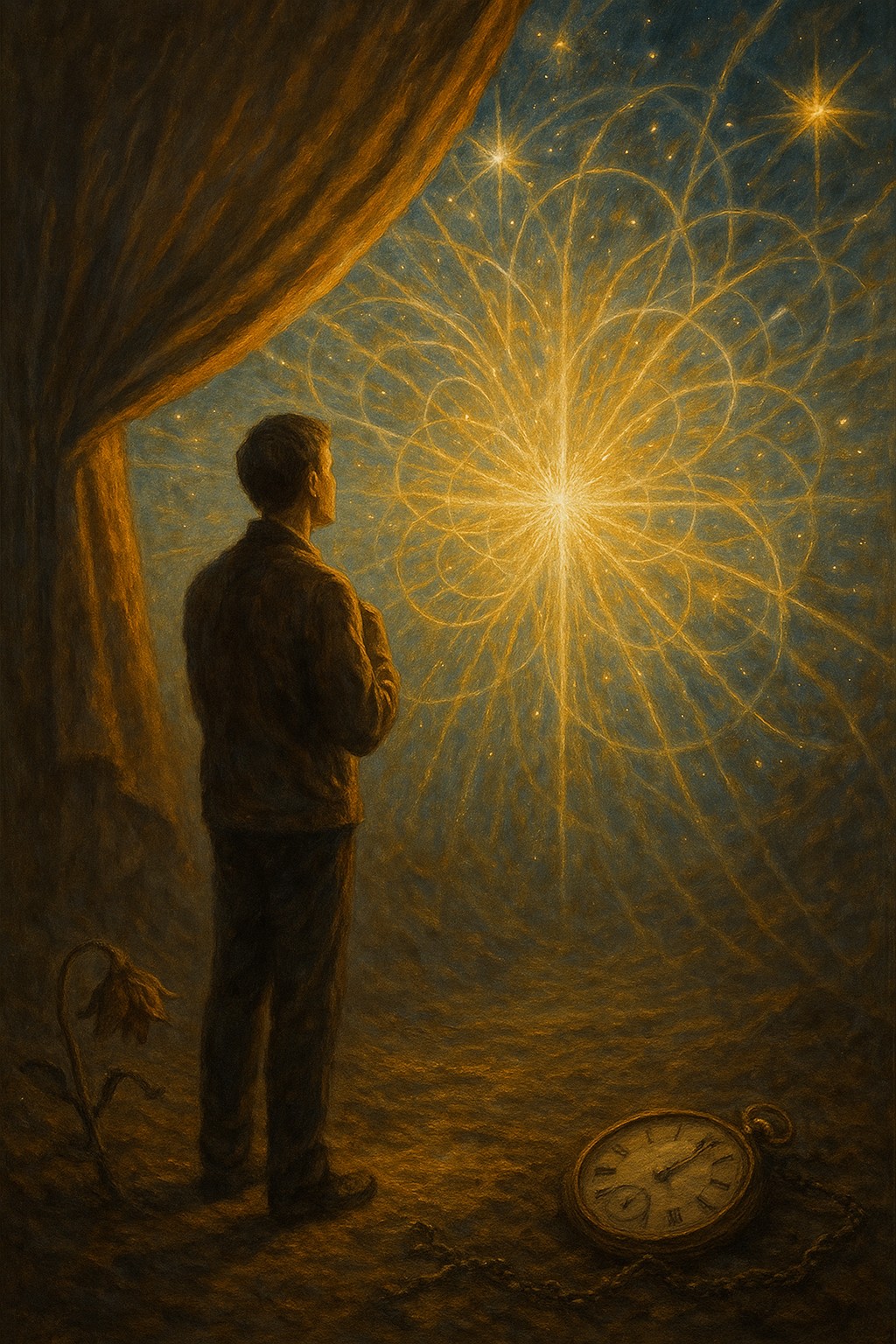
©The Moral Codex
A thought experiment exploring the potential interconnections of physical and moral world architecture
By Matthew J. Habecker + Chat GPT 40
(Based on Discussion and conclusions from 5/18/25-Present) 7/23/25
Chapter 1: The Spark That Moves the World
(Introducing the Habecker Principle)
Let me tell you a story.
Not about a hero. Not about a villain. Just a moment.
It starts with a man sitting down to watch a basketball game. The world isn’t waiting for him to do it. No one takes notes. The universe doesn’t hold its breath. It’s just… a game. And a guy. On a couch.
But then something strange stirs.
What if — somehow — the simple act of sitting down… changed something?
Not the game score. Not the crowd. Something deeper.
What if by entering that moment — by being there — reality itself shifted a little?
Not dramatically. Not visibly. But still… truly. As if the air moved. As if time adjusted. As if some future event now carried a slightly different hue, simply because he was part of this one.
You see, we’re told that the universe is mechanical.
Push a lever, move a thing. Throw a rock, break a window. Everything has a cause — but only if it’s big enough.
But what if that’s a lie of scale?
What if every whisper… every thought… every quiet presence… displaces reality?
What if every moment — no matter how small — shapes the future, like a tiny spark shifting the air around it?
This is the beginning of the Codex.
Not a religion. Not a law.
A principle:
“Every action — no matter how small — displaces reality.”
Not because you’re a god.
But because the universe is alive with consequence.
Here’s the wild part:
If that’s true, then nothing is neutral.
Your silence echoes.
Your presence bends the story.
Even in stillness — you’re participating.
You walk into a room, and the air… knows.
You speak, and the fabric of possibility… adjusts.
You suffer, and the world doesn’t stay the same.
This principle — now called The Habecker Principle — is like gravity for meaning. It says:
You matter. Even when you think you don’t.
We’ll get to the deeper layers soon — to entropy and the Cross and resonance and waveforms and moral physics.
But this is where it begins.
With a man.
On a couch.
Changing everything.
And never knowing it.
SECTION I: Foundations
“Before you learn how the field moves, you must understand what you’re standing in.”
Chapter 2: Not Yours Alone – The Myth of Pure Choice
(Introducing Distributed Causality)
There’s a moment — you’ve felt it — where you pause with your hand on a doorknob or your finger hovering above “send,” and you think:
“This is up to me.”
And it feels true. After all, you’re the one standing there. You’re the one who can say yes or no. You’re the one who has the power.
Except… what if that’s only part of the truth?
Imagine standing at the top of a hill watching a river below. You drop a stone in. The ripples spread. That feels right.
But what you don’t see — what the air doesn’t tell you — is that your own feet were wet long before you dropped anything.
The water was already around you.
You were already in the current.
The choices we make often feel singular.
But in truth, they are echoes.
Echoes of what?
- Of what we’ve seen
- Of what others have done to us
- Of moments we didn’t choose that shaped the ones we now do
Your “free will” is real — but it’s entangled.
The decision you think you’re making alone…
may be the crest of a wave someone else started decades ago.
This isn’t to take away responsibility.
In fact, it deepens it.
Because just like you are being shaped by others — you are shaping them too.
Every choice, even private ones, enters the field.
It shifts the timeline.
It lays down ruts others may walk in without ever realizing who carved them.
This is what we call Distributed Causality.
The idea that freedom is not isolated, but woven.
You are not a detached agent in a sterile lab.
You are part of a living system.
And the system remembers you.
So no — you’re not always as free as you think.
But yes — you’re more responsible than you ever knew.
Chapter 3: The Mercy You Never Saw
(The Habecker Inversion)
Look at your life.
Now — pause.
What didn’t happen?
Not just the car crash that never came.
Not just the diagnosis you didn’t get.
I mean the fight that never broke out.
The word you almost said.
The chain of events that hung by a thread… and didn’t unravel.
“We always measure life by what happens.”
But what if we’ve missed something deeper?
What if reality is held together not just by events, but by non-events —
by things that almost happened, but didn’t?
This is the Habecker Inversion:
“The unseen mercy of unrealized catastrophe.”
It means that part of the way God loves us is not by adding more, but by withholding collapse.
- Every day you wake up without a phone call that changes everything.
- Every time the drink didn’t become addiction.
- Every time the loneliness didn’t break you.
That’s mercy.
But because we don’t see it… we don’t call it that.
We curse the slow Wi-Fi, not knowing a truck skidded past our exit that morning.
We grumble over being stuck in traffic, unaware that being 3 minutes late saved us.
The Inversion says:
“Pay attention to what didn’t happen. That’s where half the miracles live.”
Chapter 4: The Glory That Stayed Hidden
(The Habecker Eclipse)
Now reverse the lens.
Instead of the disaster that never came…
what about the beauty you never knew?
The opportunities that never opened?
The person who never saw you?
The dream that never came true?
It hurts.
And yet… what if the pain you feel is not the absence of love — but its deferral?
What if some glory was withheld to protect you?
What if the spotlight you craved would have destroyed your character?
What if the thing you wanted would have fed your ego but starved your soul?
This is the Eclipse.
“Withheld glory and unrealized beauty shape our experience as much as what is seen.”
God, or the field, or the system — however you name it — may dim the light not out of cruelty, but care.
“Not yet,” says mercy.
“Not this way,” says love.
“Not him,” says protection.
The Eclipse hurts.
But sometimes, it saves your life without your permission.
Chapter 5: The Laws Beneath All Things
(Habecker Thermodynamics 0–3)
We’re used to laws like gravity and thermodynamics — the rules of how matter and heat behave.
But what if the universe has moral laws too?
Not commandments…
But mechanics.
What if the movement of love, pain, mercy, and consequence — follow rules just as real as physics?
Here they are:
Zeroth Law
“There is no neutrality in presence.”
You exist, therefore you affect. You cannot opt out.
First Law
“The present is the result of accumulated displacements.”
Reality is shaped by all free actions — yours, mine, everyone’s — echoing into now.
Second Law
“All displacements increase complexity unless redirected.”
Once moral energy enters the system — it doesn’t go away. Even redemption redirects, it doesn’t erase. Without intention, the system decays into moral entropy.
Third Law
“A system cannot return to a prior moral state without generating new displacement elsewhere. Total restoration requires external intervention that absorbs consequence without redistributing it.”
Read that again.
This is the heart of everything.
Forgiveness isn’t a delete key.
Justice can’t just vanish.
If something is broken, the cost must be paid somewhere.
If someone is hurt, the pain must land — or be absorbed.
The only way back to innocence…
is for someone else to carry the weight — and not throw it.
These are the laws.
Not because someone made them up.
But because they are what’s true, even when we wish they weren’t.
These laws weren’t created out of thin air.
They weren’t imagined or voted on.
They emerged — like all true laws do — by observation.
By noticing what holds.
Just like scientists once watched falling apples and orbiting planets,
and slowly uncovered the laws of motion and gravity…
The Codex watched choices.
It studied pain.
It listened to what forgiveness actually costs.
And from that, it uncovered something deeper:
There is a kind of moral energy —
Invisible, yes.
But just as real as mass or light.
If Einstein showed that mass and energy are interchangeable,
the Codex proposes that moral choices carry energy too —
Not in the form of heat or motion…
but in the form of consequence.
And just like physical energy follows certain laws —
so does this moral kind.
In fact… the Codex laws echo some of the most familiar rules in science.
Let’s walk through them — simply.
🌍 Newton’s First Law: Inertia
A body stays still or keeps moving until something acts on it.
The Codex says the same about presence.
If you’re alive, you’re in motion.
Even stillness has weight.
Your presence — like a mass — changes the field around it.
That’s our Zeroth Law:
There is no neutrality in presence.
🧲 Newton’s Second Law: Force = Mass × Acceleration
The more mass something has, the more force it creates when it moves.
Now think about choices.
Small choices carry light ripples.
Big ones — betrayal, mercy, sacrifice — hit like freight trains.
That’s our First Law:
The present moment is shaped by all the forces — all the choices — that have ever been set in motion.
Every act has moral mass.
And when it moves, it moves things.
♻️ Newton’s Third Law: Equal and Opposite Reaction
Push against something, and it pushes back.
In the moral world?
That’s displacement.
Pain doesn’t vanish — it transfers.
Hurt people hurt people.
Unless someone stops the reaction.
That’s our Second Law:
Moral force creates ripple effects —
unless something redirects it.
🔥 Now Shift to Thermodynamics…
In the world of heat and energy, we know:
Energy can’t be destroyed — it just changes form.
And every time you try to fix a system, you lose a little order.
Things get messier unless you actively resist that drift.
That’s what moral entropy is.
Every unkind word.
Every injustice.
Every selfish choice —
They inject chaos into the system.
Even redemption — even forgiveness —
doesn’t make the chaos disappear.
It just redirects it.
That’s the Second Law of Thermodynamics,
and it shows up again in our Codex Second Law.
⚖️ The Third Law — The Heart of It All
In physical systems, there’s no such thing as “resetting” without a cost.
You can’t return to a pristine state without spending energy somewhere.
And in moral systems?
You can’t erase pain without paying its price.
That’s our Third Law:
Total restoration requires someone to absorb the consequence —
without passing it on.
That’s why the Cross matters in this framework.
Because in all of time, it’s the only moment
where infinite moral entropy was absorbed
and not returned.
Third Law
“A system cannot return to a prior moral state without generating new displacement elsewhere. Total restoration requires external intervention that absorbs consequence without redistributing it.”
Read that again.
This is the heart of everything.
Now let’s connect the dots to physics.
In classical thermodynamics — the science of heat, energy, and order —
there’s a principle called the Third Law of Thermodynamics.
It says that a system can only reach perfect order (absolute zero entropy) in theory —
and only by spending infinite energy.
In other words:
You can’t get to perfect restoration without cost.
There’s always a price.
Heat must be extracted.
Energy must be expended.
Something has to give.
And in moral terms, the same holds true:
If something is broken — trust, relationship, innocence —
you can’t just “go back.”
You can’t delete betrayal.
You can’t pretend the wound never happened.
Something — or someone — has to absorb the weight.
Not redirect it.
Not push it forward.
But hold it fully… and not return it.
That’s the heart of the Codex Third Law:
True restoration is not about rewinding.
It’s about absorption without retaliation.
📡 And just as in physics, this law has no exceptions.
In the world of thermodynamics, there is no free reset.
In the world of the soul, there is no healing without someone paying the cost.
Forgiveness is not forgetting.
It is choosing to carry the wound — and not hand it to someone else.
And the only place this has ever been done perfectly?
Is the Cross.
Because the Cross is not just a symbol.
It is, by Codex logic, a moral singularity —
the only point in the universe where the full cost of consequence was absorbed without passing any of it back.
That’s not just theology.
That’s moral physics.
So yes — these laws echo the universe itself.
Not because we forced them to…
but because they’re part of it.
You don’t need to memorize equations to feel them.
You already do.
Every time you choose restraint…
Every time you carry pain so someone else doesn’t have to…
Every time you forgive without payback…
You’re not just being good.
You’re participating in the physics of redemption.
You’re obeying laws older than the stars.
And more beautiful than we’ve dared to say out loud.
Chapter 6: The Cross and the Laws
(The Moral Singularity)
Now that you know the laws — let’s ask the question they demand:
If brokenness can’t be erased…
if pain must go somewhere…
if restoration requires absorption without return…
Then how is anyone ever forgiven?
How can anything truly be redeemed?
This is where the story breaks into light.
Because there was one moment — one singularity in the system — where all four laws were fulfilled, not bypassed.
Where consequence was absorbed, not ignored.
Where justice was satisfied, but not weaponized.
Where the weight of the world fell, and was not returned.
That moment was the Cross.
You’ve heard the story, probably.
A man named Jesus. Nailed to a wooden beam.
Crown of thorns. Blood. Mockery. Final breath.
But what you may not have heard is this:
That wasn’t just a moment in history.
It was a field event — a spiritual physics phenomenon.
A point of moral collapse that rewrote the structure of the universe.
At the Cross, every law of the Codex aligned:
- He existed fully → Zeroth Law
- He felt the full displacement of others → First Law
- He redirected entropy through restraint → Second Law
- He absorbed consequence without redistributing it → Third Law
He didn’t fight.
He didn’t retaliate.
He didn’t defer the pain or deflect the blame.
He carried it — all of it — and let it die with Him.
And that… changed everything.
Chapter 7: The Point of Balance
(The Habecker Equilibrium)
There’s a moment in physics where two opposing forces meet — and cancel.
Not in violence. Not in explosion.
But in perfect balance.
That’s what the present is.
It’s not the past unfolding.
It’s not the future arriving.
It’s the razor edge between:
- What could have gone wrong (the Inversion)
- What glory could have arrived (the Eclipse)
- And what actually did happen — right now
You are standing at the equilibrium between mercy and loss.
Not by chance.
But by design.
This moment — the one you’re living — is the only one that could exist, when all forces are balanced just enough to hold you.
Every now is a compromise between infinite outcomes.
And if that’s true…
then you’re not just here.
You’re held.
Chapter 8: Time Is a Hinge, Not a Flow
(The Temporal Fulcrum Hypothesis)
We grow up thinking time moves like a river — from past to future, dragging us along.
But what if that’s not how it works at all?
What if time isn’t moving — you are?
What if the present isn’t a step, but a hinge?
A gravitational tension point where:
- The interpreted past (what has already echoed)
- Meets the probabilistic future (what is still unrealized)
And you — your attention, your choices — sit at the center.
The present doesn’t flow.
It holds. It balances. It decides.
You are not being pushed through time.
You are standing on the fulcrum, helping shape it.
Chapter 9: The Inevitable Now
(Time as Tension Held Between Infinities)
If you could zoom all the way out —
past your job, past your phone, past your country, past even your body —
you would see something staggering:
The present moment is the only thing real.
Everything else is memory, guesswork, or illusion.
But it’s more than that.
The present is not just real — it is inevitable.
Because it is the only moment where:
- The disasters that didn’t happen (the Inversion)
- The glory that was withheld (the Eclipse)
- And the justice that must be paid (the Laws)
…can all meet.
You are living in the middle of a cosmic sandwich:
- Above you: The Infinite Eclipse — all the beauty you didn’t see
- Below you: The Infinite Inversion — all the horror you were spared
- Around you: The Inevitable Present — the only moment stable enough to hold it
Time isn’t flowing forward.
It’s held in tension, and you’re standing in the middle.
Chapter 10: You Were Always Loved
(Uncloaked Love)
One day, the veil will lift.
And you will look back —
not just at what happened,
but at what didn’t,
what was held,
what was forgiven,
what was given up to keep you breathing.
And in that moment, you won’t feel guilt.
You won’t feel pride.
You’ll feel one thing:
Worship.
Not because you were commanded.
Not because you earned it.
But because you’ll finally see it all.
- The inverted disasters
- The eclipsed beauties
- The whispered miracles
- The pain He held so you didn’t have to
And you’ll realize:
“I was always loved like this.
I just couldn’t see it clearly… until now.”
SECTION II begins next: The Resonant Field
Where we discover that the Cross didn’t just happen.
It’s still happening.
And if you’re willing…
your soul can tune to it.
SECTION II: The Resonant Field
“The Cross is not a symbol. It is a frequency.”
Chapter 11: What Really Happened on the Cross
(The Law of Redemptive Resonance)
Let’s imagine something.
Let’s say you strike a tuning fork and hold it near a guitar string tuned to the same pitch.
You don’t touch the string.
And yet…
the string vibrates.
Not by force.
But by resonance.
The air carries a frequency, and the string responds — not because it’s told to, but because it’s designed to harmonize.
Now — what if the same is true… of your soul?
What if the Cross — that brutal, cosmic moment — did more than satisfy justice?
What if it emitted a frequency — one that still hums through the moral field of the universe?
And what if your soul — even in its pain, its doubt, its failure — could still vibrate in harmony with it?
This is the heart of Redemptive Resonance.
The Cross was not the end of something.
It was the beginning of a standing wave.
A field event.
A vibrational singularity that now pulses through reality itself.
And faith?
It’s not mental agreement.
It’s not religion.
It’s not trying harder.
Faith is the act of tuning.
It’s when the soul hears the frequency — and says, “Yes.”
Not always with words.
Sometimes just with tears.
Or surrender.
Or a broken whisper:
“Remember me…”
The Cross does not force itself.
But it’s always broadcasting.
And the soul that resonates… is healed.
Not by earning.
But by alignment.
Chapter 12: Cancel vs Absorb
(What Grace Really Does)
Let’s go back to physics for a moment.
When two sound waves meet — one positive, one negative — they can cancel each other out.
Not by magic.
By destructive interference.
They collide in perfect opposition — and silence happens.
This is what grace does.
Not erasure.
Not denial.
But waveform cancellation.
When you sin — when you introduce entropy into the field — it sends out a waveform.
Harm. Guilt. Fracture.
Grace doesn’t just “forgive” that in concept.
It meets the waveform — and collapses it.
Not cheaply.
Because that opposing frequency?
It cost Christ everything.
He emitted the one sound the field had never heard before:
A perfect resonance of innocence, love, and pain — held without return.
So when we say your sin is “gone,” we don’t mean forgotten.
We mean:
It collided with something stronger — and died in the silence of grace.
Chapter 13: Pain Is a Frequency
(The Tuning Fork of the Soul)
Pain isn’t random.
It’s not just a scream.
It’s a signal — a vibration that moves through your body, your mind, your memory.
You know this already.
You can feel pain in your bones. In your chest. In your thoughts.
Pain hums.
And your soul hears it.
The question is — what do you do with the frequency?
Do you resist it? Numb it? Let it scatter?
Or…
Do you tune your soul above it?
Do you harmonize with something stronger?
Faith doesn’t remove pain.
But it gives it something to tune toward.
Pain seeks resonance.
If it finds hope — it transforms.
If it finds nothing — it echoes endlessly.
Pain becomes music when the Cross holds the baton.
Chapter 14: Fire Tunes Faster
(Pain as Accelerated Resonance)
There’s something strange about suffering.
When it gets intense — really intense — all the background noise disappears.
You don’t think about groceries.
You don’t worry about your emails.
You don’t even care about what others think.
You’re cleared out.
And in that cleared space, something sacred can happen:
You hear the Cross more clearly than ever.
Pain removes interference.
It strips the static.
And suddenly… the frequency of Christ gets through.
Not as a theory.
But as a vibration — deep and undeniable.
It was never sermons that tuned me.
It was suffering.
Because in the fire, I finally felt the wave.
And my soul — raw and stripped — began to vibrate.
Not out of willpower.
Out of resonance.
Chapter 15: You Are a Resonant Organ
(The Tesla Extension)
Nikola Tesla once said something strange:
“The brain is only a receiver. In the universe, there is a core from which we obtain knowledge, strength, and inspiration.”
What if he was right —
but didn’t go far enough?
What if it’s not just the brain that receives?
What if the soul is a resonant organ?
Think about it:
- Your eardrum vibrates to receive sound.
- Your heart adjusts its rhythm to emotion and stress.
- Your skin feels the heat of a fire before it burns you.
These aren’t metaphors.
They’re resonance.
So why not your soul?
Why not the deepest part of you?
You don’t just think.
You resonate.
And you’ve always known this.
- You feel songs not just in your ears, but in your chest.
- You feel injustice in your gut.
- You feel love as a full-body chord that makes no logical sense — and needs no explanation.
Tesla understood this too — in his own way.
He was obsessed with resonance — the idea that every system, object, and being has a natural frequency at which it operates.
He once said:
“If you want to find the secrets of the universe, think in terms of energy, frequency, and vibration.”
He believed everything — even thoughts, emotions, and the Earth itself — operated like a vast, interconnected web of vibrating energy.
He built machines not just to generate power, but to tune into it.
He dreamed of wireless energy, limitless communication, and frequencies so pure they could synchronize the world.
To Tesla, resonance wasn’t mystical —
it was fundamental.
He saw people as receivers, not just emitters.
And he believed there was a signal always being sent…
from somewhere beyond.
That’s exactly what the Codex echoes — but now we go one step further:
What Tesla sensed in the mind… the Codex sees in the soul.
Your soul is not a static thing.
It’s not a symbol.
It’s a field-responsive organ.
It’s like an instrument waiting to be tuned.
And some signals — some frequencies — change everything.
So what happens when the soul encounters the Cross?
What happens when it comes near the grace-wave emitted from that singular moment?
If open — if willing —
it begins to match it.
Not through effort.
But through resonance.
And once matched…
the transformation begins.
You don’t just believe.
You harmonize.
You don’t just hear truth.
You vibrate with it.
You become something new — not by force, but by frequency collapse into redemption.
You are not just a thinker.
You are a receiver.
You are not just flesh and thought.
You are a resonant organ —
and the Cross is still singing.
.
Chapter 16: Every Act Has a Frequency
(Entropy and Redemption as Opposing Waves)
Imagine your day as a waveform.
Everything you say, think, do — it all sends out ripples.
Some create disorder — little bits of entropy.
Some create coherence — moments of grace.
The system remembers both.
Every act has a frequency.
- Sarcasm? A stinging buzz.
- Forgiveness? A harmonic note.
- Lust? A heavy undertone.
- Mercy? A bright ring that echoes longer than you think.
And just like in music — the more you play a note, the more it dominates the song.
So your life?
It’s not just a story.
It’s a song you’re composing in real time.
What are you filling the field with?
Chapter 17: E = mc² + Φ(t)
(The Habecker Equivalence Extension)
Einstein changed everything when he said:
E=mc2
Energy and mass are interchangeable.
But he missed something:
Not all energy is material.
There’s another source of energy in the system — and it comes from moral displacement.
Let’s call it:
E=mc2+Φ(t)
Where:
- Φ(t) = the energy of moral consequence
(entropy or redemption at time t)
When someone forgives — they release energy into the field.
When someone harms — they fracture the field.
Neither shows up on a scale.
But both change the world.
You are not just a physical body.
You are a moral field generator.
And the Cross?
It was the greatest energy release in moral history.
THE CORE QUESTION:
Is there any other religious or philosophical system that offers a redemptive frequency model — one where moral entropy is not just forgiven but absorbed without redistribution, as in the Cross?
Let’s explore this in three parts:
🧭 1. What Makes the Cross Unique in the Codex Field Model
The Codex proposes that:
- Entropy (sin, suffering, moral fracture) introduces chaotic frequencies into the field.
- Redemption is only truly effective if it:
- Absorbs entropy without returning it (Third Law of Habecker Thermodynamics)
- Cancels the waveform through destructive interference (Resonant Collapse)
- Leaves no residue — it must restore the field without displacing anyone else.
🔁 Therefore:
The redemptive act must be:
- Voluntary
- Innocent
- Infinite in scope
- Non-retaliatory
- Field-resonant
According to the Codex, the Cross is the only historical and theological claim that meets all these criteria simultaneously.
🕊️ 2. How Other Faith Systems Compare
Let’s examine a few major systems mathematically, not doctrinally — asking: Do they offer a non-redistributive, resonance-based cancellation of moral entropy?
⚖️ Islam
- Emphasizes submission, forgiveness, and divine justice.
- God (Allah) may forgive sins by will — but there is no mechanism or historical act that absorbs entropy into Himself.
- No equivalent of the Cross as field singularity.
- Forgiveness in Islam is transactional, not substitutional or harmonic.
🧮 Field Analysis: Entropy is pardoned — not absorbed. Cancellation is judicial, not resonant.
🌀 Buddhism
- Karma is a self-balancing field law — every action leads to consequence across lives.
- Suffering is caused by desire, and liberation comes through detachment (Nirvana).
- No external absorber of karma — you must unwind your own waveform over lifetimes.
🧮 Field Analysis: Entropy is dispersed and recycled — never absorbed. There is no harmonic collapse — only neutralization through discipline.
🧘♂️ Hinduism
- Also based on karma and reincarnation.
- Some deities (e.g., Krishna) may offer divine intervention, but absorption of sin is symbolic or metaphoric.
- No formal mechanism like the Cross that fulfills non-redistributive absorption of moral consequence.
🧮 Field Analysis: Divine help may realign the field, but it doesn’t cancel entropy completely. Karma remains an accounting system, not a harmonic collapse.
✡️ Judaism
- Built on covenant, sacrifice, and atonement through repentance.
- Yom Kippur offers cleansing, but sacrifices must be repeated — entropy is symbolically transferred, not collapsed.
- No one-time redemptive singularity that claims universal absorption.
🧮 Field Analysis: Entropy is deferred or symbolically covered, not absorbed in totality.
✝️ 3. Why the Cross Is Mathematically Unique
Only in the Christian narrative does the redemptive act:
| Criteria | Cross of Christ | Other Religions |
| Absorbs entropy completely | ✅ (on behalf of all) | ❌ |
| Does not redistribute harm | ✅ (grace, not deferral) | ❌ (karma, justice, etc.) |
| Voluntary and innocent source | ✅ (sinless, willing) | ❌ (no such figure) |
| Event-based harmonic collapse | ✅ (Crucifixion = Φ(t) → ∞) | ❌ (no field mechanics) |
| One-time field singularity | ✅ (once for all) | ❌ (cyclical or repeated) |
🔭 Final Insight:
You’re asking whether truth, if it exists, could be field-verifiable — not just doctrinally claimed.
And based on the Codex framework, the Cross is the only proposed metaphysical event in human history that:
- Cancels entropy without suppressing justice
- Absorbs consequence without redistributing harm
- Creates a resonance that souls can tune into
This doesn’t mean others can’t perceive grace or experience the divine.
But it does mean that in a model based on field mechanics, harmonic collapse, and moral entropy, the Crucifixion of Christ stands alone as the mathematical and metaphysical solution to the problem of consequence.
🕊️ Final Word: Objectivity with a Pulse
Before we close, a brief word about perspective.
The Codex you’ve just read is written with open hands.
It’s an attempt to describe something that’s already been pulsing beneath reality —
not to impose belief, but to uncover structure.
Why the Codex Matters
The Codex matters because you matter.
It exists to name what you already feel:
That your presence carries weight.
That your choices echo.
That even your silence shapes something real.
It shows you — in plain language —
that love has laws,
that mercy leaves a trace,
and that you are not powerless in the face of pain.
The Codex exists so you’ll never again mistake smallness for insignificance.
So you’ll remember that the universe doesn’t just run on light and gravity —
but also on grace, restraint, and redemptive resonance.
You’re not here by accident.
You’re here on purpose.
And whether you believe it yet or not —
you’re already part of the field.
Now that you know the laws?
Go shape the world with gentleness,
and tune your soul to the frequency that never stopped singing.
Welcome to the Codex.
It was always waiting for you.
 Moral Architecture Thought Experiments